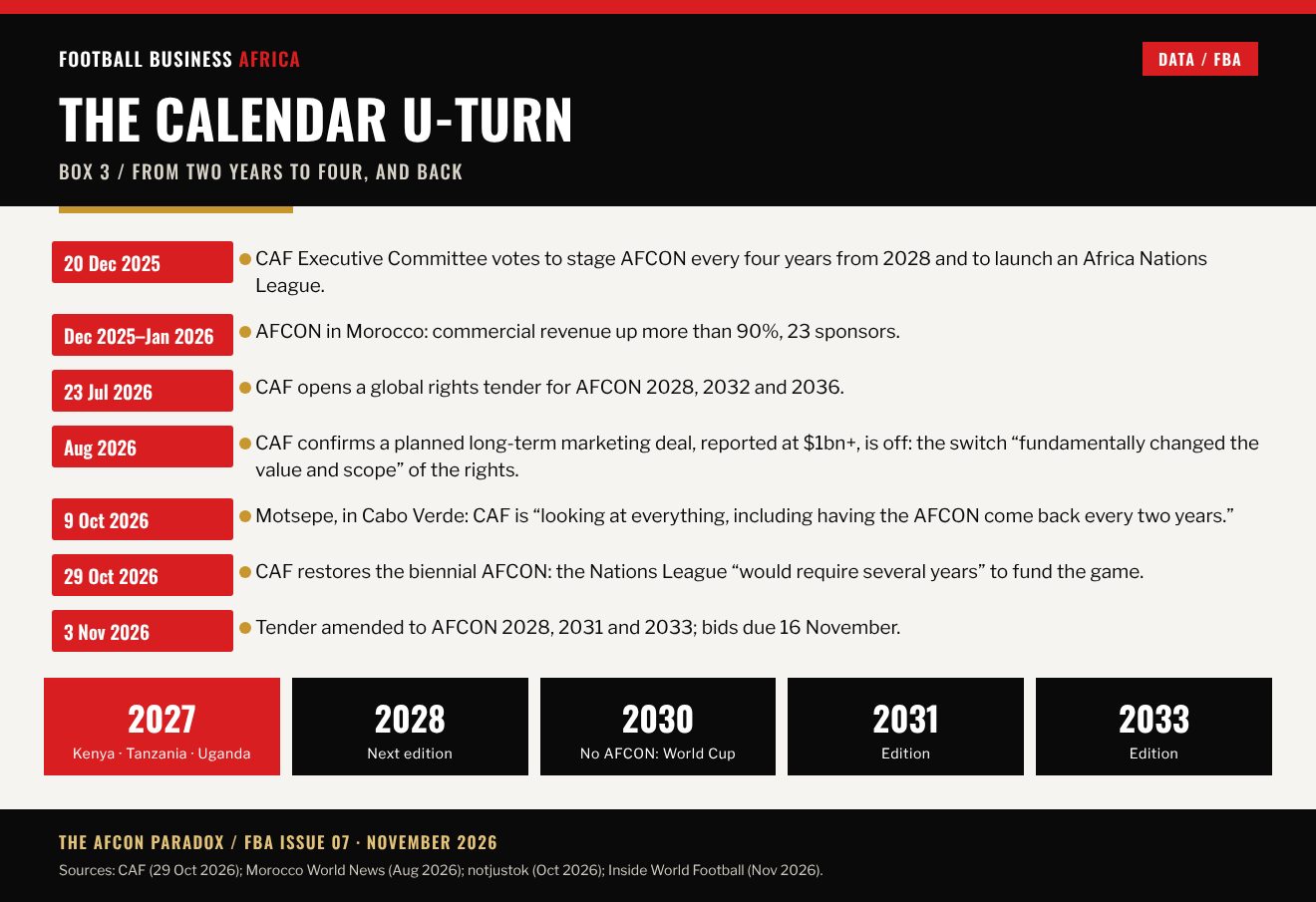
On 29 October 2026, African football's governing body made a remarkable admission. Ten months after announcing that the Africa Cup of Nations would move to a four-year cycle, the Confederation of African Football (CAF) changed its mind. The tournament would stay every two years — because nothing else could yet pay the bills.
The reform had been ambitious. A new Africa Nations League would give the continent another international competition, while AFCON adopted a calendar like Europe's continental championship. But there was a problem. In CAF's own words, the replacement competition "would require several years in order to be in a position to contribute the substantial financial resources necessary" to sustain African football.
That sentence reveals one of the central contradictions of the African game. The continent has an extraordinary football culture, globally recognised players, fiercely supported clubs and one of international sport's most compelling tournaments. Yet its institutions still struggle to turn that appeal into more than one dependable commercial property.
AFCON has become both African football's greatest commercial success and its most significant financial dependency. Why?
The Tournament That Pays the Bills
The numbers explain why CAF found it so hard to let go.
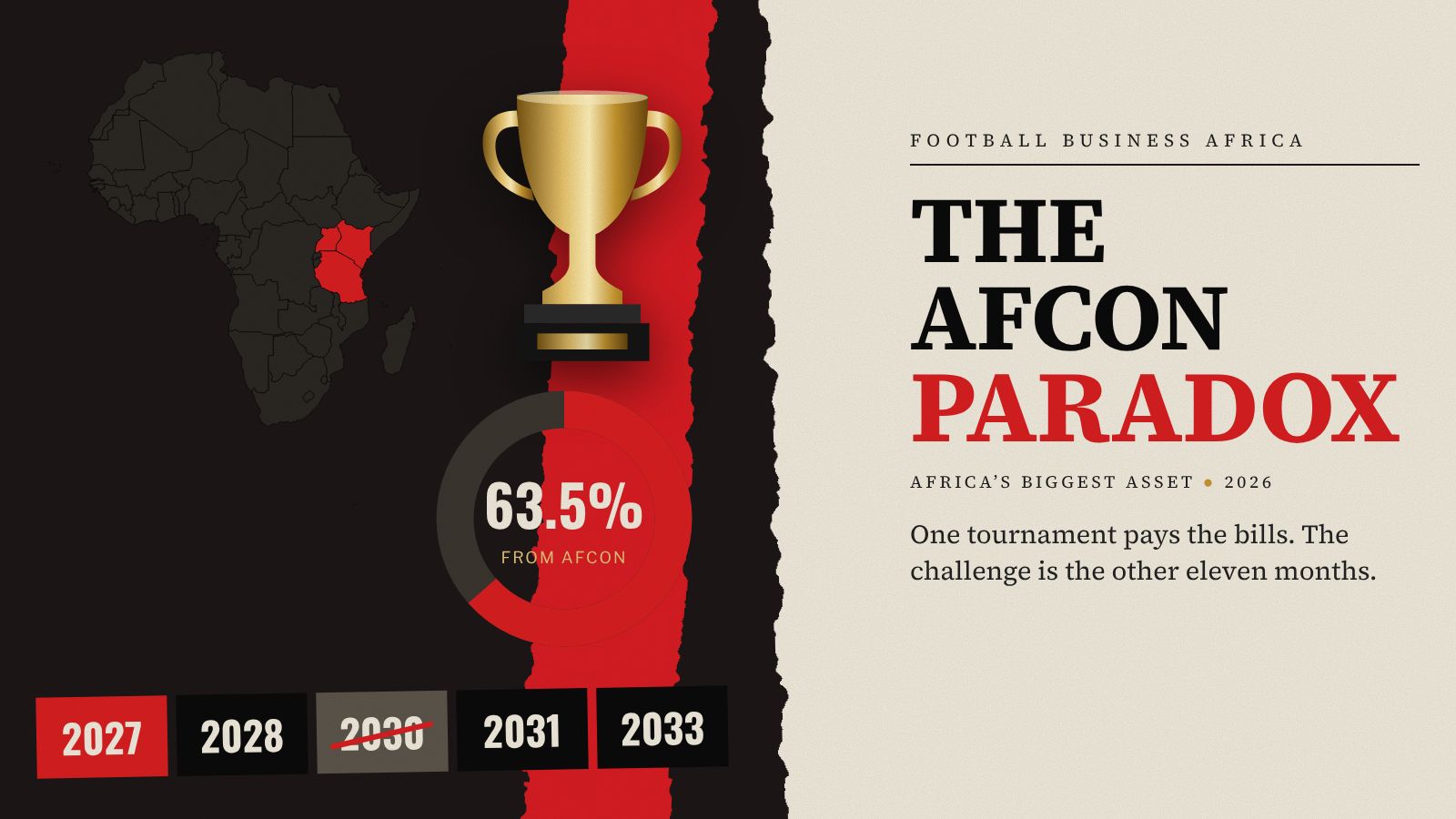
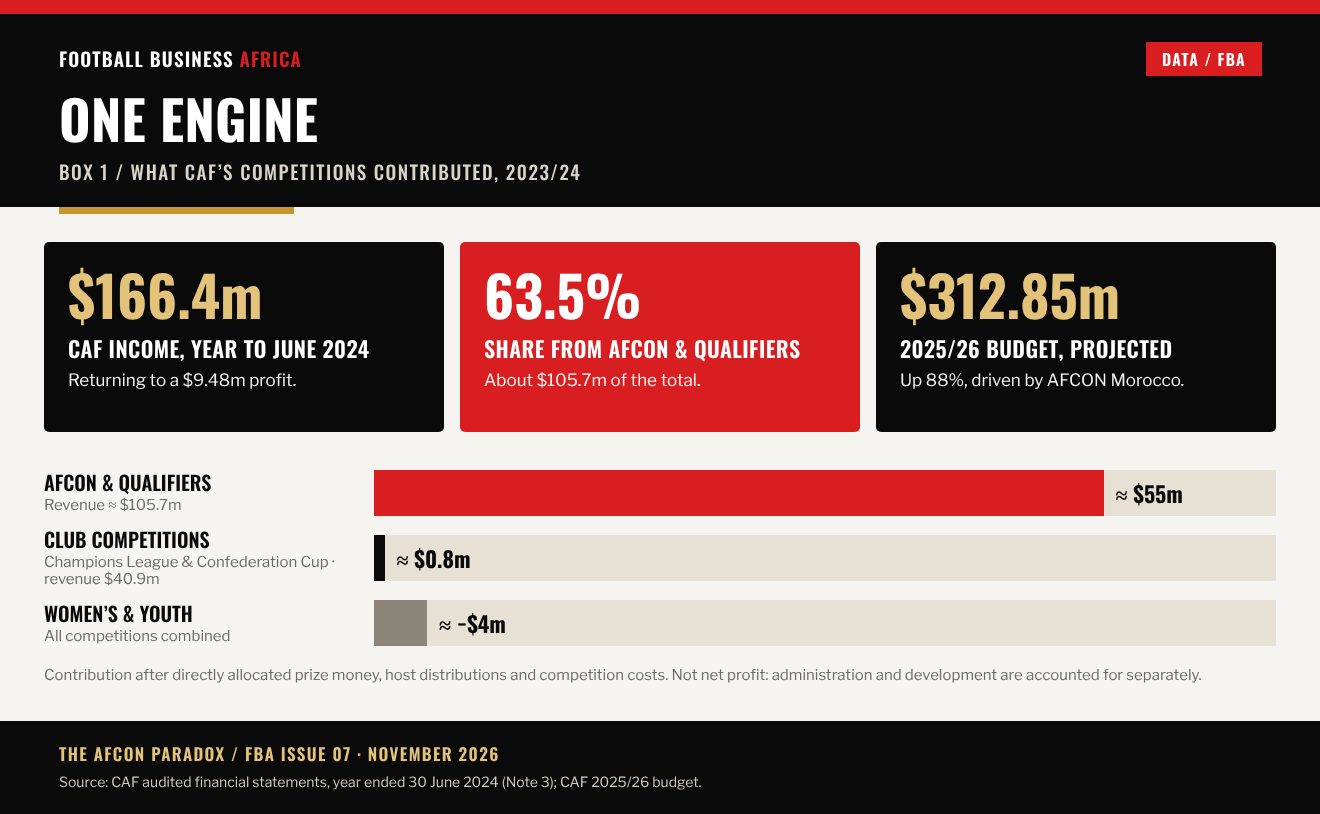
In the year to June 2024, according to its audited financial statements, CAF earned $166.4 million and returned to a $9.48 million profit. About $105.7 million of that income — roughly 63.5% — came from AFCON and its qualifiers. After directly allocated prize money, host payments and competition costs, the AFCON family contributed about $55 million. CAF's club competitions, the Champions League and the Confederation Cup, generated $40.9 million in revenue but contributed only around $800,000 after comparable costs. Women's and youth competitions together were about $4 million in the red.
These are not net profits: administration, development programmes and other items sit elsewhere in the accounts. But they show how heavily CAF's capacity to fund everything else depends on one men's national-team tournament.
The picture has since improved. CAF's 2025/26 budget projected revenue of $312.85 million, up 88%, driven by the tournament staged in Morocco from December 2025 to January 2026. CAF later said commercial revenue from that edition had risen by more than 90%, with 23 sponsors against nine in 2021, without publishing the absolute figure. Those are projections and announcements, not audited results. The imbalance remains.
Why AFCON Works
AFCON benefits from advantages that are hard to reproduce.
First, it mobilises nations. A match involving Senegal, Nigeria, Cameroon, Egypt or Morocco reaches far beyond club supporters; national loyalties cut across generations, regions and the diaspora. Second, it brings Africa's global stars home. Players who spend the season in Europe return to represent countries with which millions keep deep ties. For broadcasters, that is a rare proposition: familiar faces, intense rivalries and a tournament whose meaning transcends sport. Third, it is already a global brand. CAF said close to two billion people followed the 2023 edition in Côte d'Ivoire; the 2025 edition generated 5.2 billion digital video views, and audiences in Europe, Asia and South America rose by 61%, according to CAF's preliminary research.
Views and "people reached" are not unique viewers or paying customers. But attention is the foundation of commercial value, and advertisers know exactly when AFCON takes place and what it represents. Creating an equivalent proposition for club football is far harder.
AFCON is not merely CAF's leading commercial property. It is the financial foundation of much of continental football.
The Missing Foundations of Club Football
African club football does not lack history, talent or supporters. Al Ahly, Zamalek, Raja, Wydad, Espérance, TP Mazembe, Simba, Young Africans and Mamelodi Sundowns are proof of that. But a commercially successful continental competition needs more than popular teams. It needs a functioning economy beneath them.
Many domestic leagues operate in markets where broadcast revenue is modest, stadiums are uneven, commercial management is thin and clubs depend on benefactors, companies or public institutions. A European club enters a continental tournament from a league with established broadcast and sponsorship structures. An African club may enter the Champions League from a championship with limited television coverage and few dependable revenue streams. Continental football can become a financial burden even when it is a sporting honour.
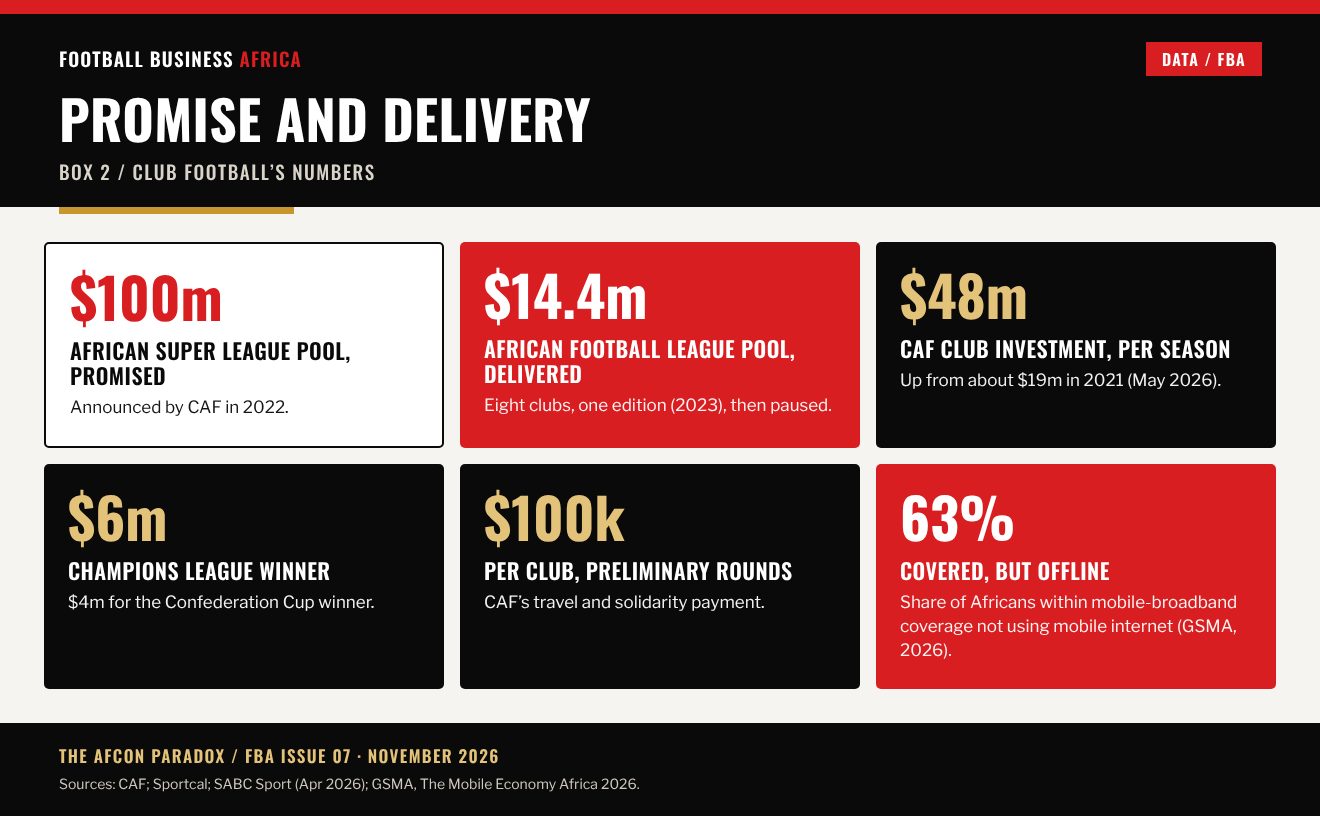
Travel is a big part of that burden. Africa's scale, expensive flights and limited direct routes make cross-border competition costly. CAF has responded: preliminary-round clubs now receive $100,000 each, and in May 2026 CAF said its investment in club competitions had risen from about $19 million a season in 2021 to more than $48 million, with $6 million for the Champions League winner and $4 million for the Confederation Cup winner.
These are meaningful improvements. But raising prize money is not the same as creating a profitable competition. If the extra money comes from AFCON surpluses rather than stronger club revenues, the dependency remains.
The Super League That Wasn't
The African Football League offers a revealing example. Announced in 2022 as the African Super League, it promised a $100 million prize pool, a premium television product and international sponsors. The inaugural edition in 2023 featured eight clubs and a prize pool of $14.4 million. Mamelodi Sundowns won it. Then the competition was paused. In April 2026, Motsepe said the sponsorship proposals received had been unsatisfactory and that the league would return only with substantial prize money.
The idea was not irrational; premium club competitions can create real value. But the gap between ambition and delivery raises hard questions. Was the market ready? Were sponsors asked to commit before an audience existed? And could a competition built around a small elite convince excluded clubs and smaller federations that its benefits would reach them? Launching a tournament and building a sustainable institution are two different things.
Broadcasting: One Event Is Easy to Sell
Media rights sit at the heart of the problem. AFCON can be packaged as a single premium event and sold to broadcasters seeking mass audiences over a few weeks. Club football needs something different: dependable fixtures across many months, consistent production, measurable audiences and a story that runs from the first round to the final.
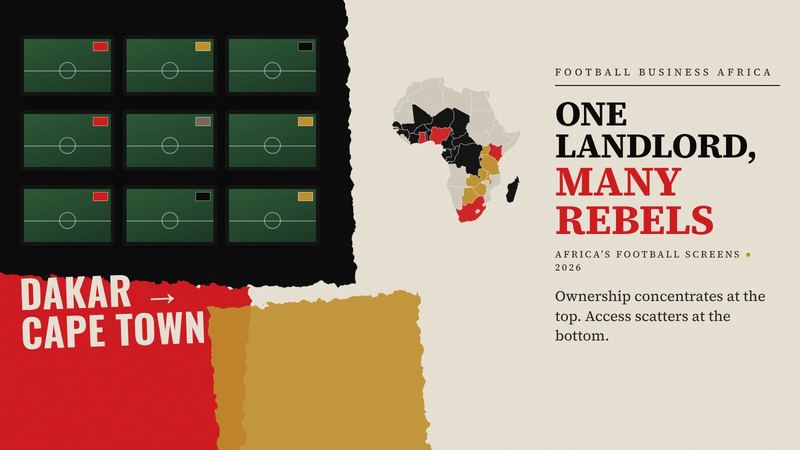
The economics vary sharply by market. North African football enjoys large television audiences; South Africa has a developed pay-TV environment; East African clubs have passionate followings; other markets have limited infrastructure or weak advertising demand. And the buyers are fewer. Since Canal+ took over MultiChoice, the two largest pay-TV bidders share an owner — the subject of One Landlord, Many Rebels in this issue. Canal+ will show AFCON 2027 in French, English and Portuguese, while two agencies resell the free-to-air rights.
Free-to-air builds audiences; pay-TV earns larger fees; streaming reaches young fans and the diaspora. They are not the same business. Nor do large online audiences automatically produce subscription or advertising income. According to the GSMA, about 63% of Africans live within mobile-broadband coverage but do not use mobile internet, held back by device and data costs. The challenge is not simply distributing African football more widely. It is building distribution models that African consumers can afford.
Three Markets, Three Directions
There are encouraging examples. Tanzania shows the value of long-term investment: in 2021 Azam Media signed a ten-year, TZS 225.6 billion (about $97 million at signing) deal for the national league, turning local football into a customer-acquisition tool for its pay-TV business and giving clubs a predictable income. South Africa shows the advantages of a mature sports-media market: Betway became the Premiership's title sponsor in 2024 and SuperSport committed to showing all 240 league matches live — though gambling sponsorship raises legitimate questions where young audiences are concerned. Nigeria is trying something else: after its deal with StarTimes collapsed, the Nigeria Premier Football League agreed in August 2026 to stream selected matches free on YouTube with Murphy Ben International, betting on visibility before revenue.
African football does not have one broadcasting market. It has many, and each needs its own model.
Women's Football: A Chance to Build Differently
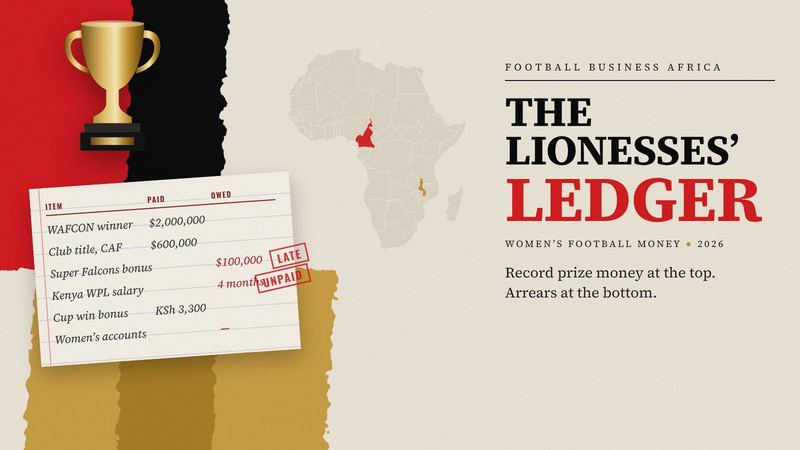
Women's football offers another path to diversification. CAF has raised the Women's Africa Cup of Nations prize fund to $5.8 million and the Women's Champions League — eight clubs, now being played in Egypt — pays its winner $600,000. These remain small properties next to men's AFCON. But present revenue should not decide long-term value. Women's competitions can be built from the start around digital distribution, measurable engagement and sustainable clubs — if they are given time and investment rather than asked for immediate profit. Our cover story, The Lionesses' Ledger, follows that money.
Africa has shown it can produce a globally compelling football spectacle. The next challenge is a business for the other eleven months of the year.
What Diversification Would Require
African football does not necessarily need more competitions. It needs more commercially sustainable ones. Six priorities stand out.
Strengthen domestic leagues. Continental competitions are worth more when their clubs have solid domestic revenue: governance, transparent accounts, reliable scheduling, better venues and dependable rights structures. CAF's club-licensing system is a foundation, but compliance on paper must become operational capacity.
Invest in production and audience data. Sponsors should be able to measure the audiences they reach, not rely on estimates of popularity. That means consistent broadcast production, accurate audience reporting and usable supporter data.
Create revenue beyond broadcasting. Tickets, hospitality, merchandise, memberships, digital content and licensing — with privacy, consent and security built in when supporter data is collected.
Develop regional markets. Regional rivalries can cut travel costs and offer sponsors coherent markets, as long as they complement domestic leagues rather than destabilise them.
Commercialise women's and youth football deliberately, with their own brands and realistic, multi-year investment horizons.
Publish competition-level accounts. CAF has improved its financial disclosure. The next step is consistent reporting of revenue, costs, rights income and distributions for each competition, so that clubs, sponsors and analysts can tell real commercial growth from spending funded by AFCON.
The Bottom Line
AFCON's success should be celebrated. Few competitions combine such intense national identification, cultural meaning and global talent, and its growth has strengthened CAF's ability to fund competitions that might otherwise not survive. There is nothing wrong with a profitable flagship subsidising the wider game.
The problem arises when the system depends on that flagship so completely that a calendar reform threatens its finances. That is the real lesson of the October U-turn. CAF did not go back to a biennial AFCON because two years is the ideal sporting rhythm. It went back because no other product could yet replace the money.
African football's central challenge is not a lack of passion, talent or history. It is the unfinished task of turning those assets into institutions, competitions and commercial relationships that earn throughout the year. AFCON may remain the continent's most valuable property for decades. The real measure of success will be whether the money and attention it generates help build a football economy that can thrive between tournaments.
Sources & further reading
- 01
The U-turn — CAF
CAF decides to return to the AFCON taking place every two years, 29 October 2026. Read the source
- 02
The U-turn — Al Jazeera
AFCON returns to a two-year cycle: 2027, 2028, 2031, 2033. Read the source
- 03
CAF's 2023/24 results — Inside World Football
$166.4m revenue and a $9.48m net profit. Read the source
- 04
CAF's 2025/26 budget — Africa24
Projected revenue of $312.85m. Read the source
- 05
AFCON Morocco 2025 — CAF
Commercial revenue up more than 90%; 23 sponsors. Read the source
- 06
Global audiences — CAF
61% growth in Europe, Asia and South America; media-rights revenue up 35%. Read the source
- 07
Digital views — CAF
AFCON Morocco 2025 breaks digital records. Read the source
- 08
AFCON 2023 audience — The New Times
Close to two billion people watched, says Motsepe. Read the source
- 09
Club investment — CAF
More than $48m per season for African clubs, May 2026. Read the source
- 10
The African Football League — Inside World Football
Africa's big new club league will offer just $14.4m. Read the source
- 11
The AFL's future — SABC Sport
The league will return only with huge prize money, says Motsepe. Read the source
- 12
Connectivity — GSMA
The Mobile Economy Africa 2026: the usage gap. Read the source
- 13
AFCON 2027 rights — Sportcal
Canal+ and SuperSport win AFCON 2027. Read the source
- 14
Nigeria's streaming bet — ThisDay
NPFL partners Murphy Ben International for YouTube streaming. Read the source
- 15
The abandoned $1bn deal — Morocco World News
CAF's August 2026 explanation. Read the source
- 16
Motsepe in Cabo Verde — notjustok
CAF reconsiders the two-year format, 9 October 2026. Read the source
- 17
The amended tender — Inside World Football
AFCON 2028, 2031 and 2033; bids by 16 November. Read the source
- 18
Women's Champions League 2026 — CAF
Eight clubs, Egypt, $600,000 for the winner. Read the source
Dollar conversions are approximate, at the exchange rate at signing where known and otherwise at 2026 rates. Figures marked "reported" come from press reports rather than official disclosures.