In mid-October 2026, 120 Congolese coaches spent three days at the Stade Tata Raphaël in Kinshasa learning from AS Monaco's academy staff. President Félix Tshisekedi came to the closing. "This was only a beginning," said Monaco's technical director. Across Africa, almost everyone agrees that academies are the beginning. Far fewer agree on what makes one work.
The continent is full of football academies: celebrated ones that have sent graduates to the Premier League, club-backed ones with European badges, and thousands of fee-paying football schools whose names promise a route to Europe. Every founder can point to a star. Few can tell you what happened to everyone else.
FBA reviewed the evidence — from FIFA's global study of 864 academies to UEFA and CAF licensing rules, peer-reviewed research, federation coaching philosophies in five languages, and the stories of academies that faltered — and asked a simple question: what does an academy that lasts actually look like, and how should one be built in Kenya, Cameroon or DR Congo?
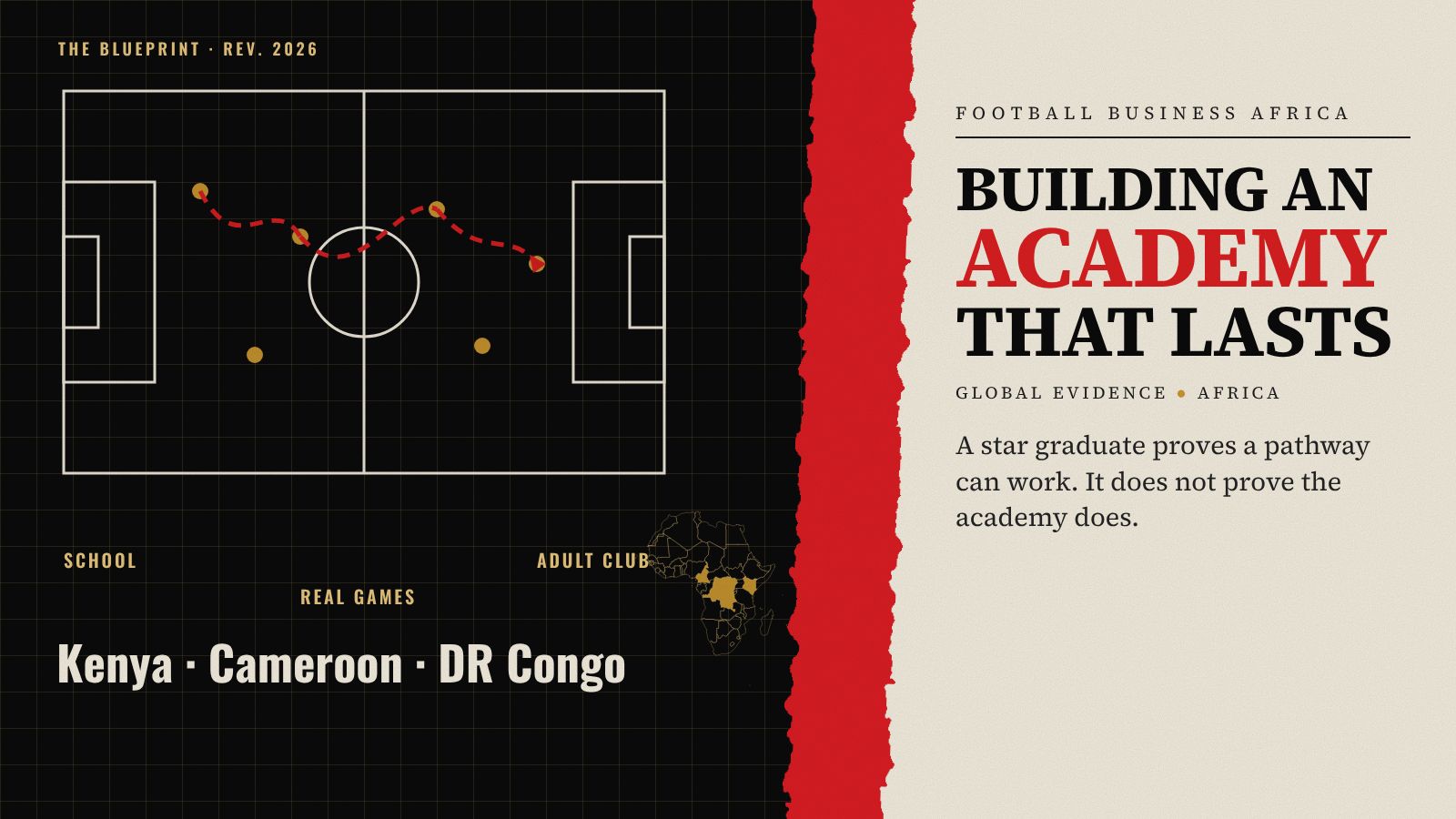
The short answer: an academy succeeds when it repeatedly turns access to football into learning, real competition and credible next steps, while protecting children and paying its bills. A famous graduate proves a pathway can work. It does not prove the academy works for an entire intake.
The Missing Denominator
There is no trustworthy worldwide "academy success rate" — and anyone who quotes one in a business plan should be asked where it came from. The best-known study, which followed 537 players at one professional academy over twelve years, found that 53, or about 10%, obtained a senior professional contract at that club. Strikingly, 68% of those who made it had been recruited at 12 or older. That is a warning against certainty and early exclusion, not a probability to apply to an intake in Nairobi or Kinshasa.
The literature itself is thin where Africa needs it most. A 2023 systematic review of 85 studies on talent development found that 60 compared groups at a single point in time; only three examined how individual players actually change. African academy accounts, full intake numbers, girls' outcomes and what happens to released players are almost entirely absent from the public record.
So the first discipline is to count properly. "Six of the 24 players leaving our under-18 programme joined registered adult clubs; four were still playing a year later" is a result. "We produced six professionals" is a slogan. Credible academies track both the children they admit and the players they release — otherwise a programme can flatter its numbers simply by letting weaker prospects go just before graduation.
A celebrated graduate is evidence that a pathway can work. It is not proof that the academy works for an entire intake.
Five Ways to Measure Success
Before choosing a model, a founder has to decide what success means. The evidence points to five outcomes, measured separately: football development (better decisions under pressure, progression to stronger teams, sustained adult minutes — not youth trophies); education and life chances, including for players who are released; welfare and access, so that children are safe and talented players are not excluded because their families cannot pay; institutional continuity, so quality survives a coach's departure or a sponsor's exit; and financial sustainability, meaning recurring costs can be met without assuming a player sale.
France offers a useful example: its assessment of professional training centres combines contracts signed, first-team minutes, international selections and schooling. The transferable idea is the balanced scorecard, not the French ranking. Even the most cited global league table, the CIES Football Observatory's 2025 academy ranking — topped by Benfica, Barcelona and River Plate — measures where trained players end up, not education, welfare or profitability.
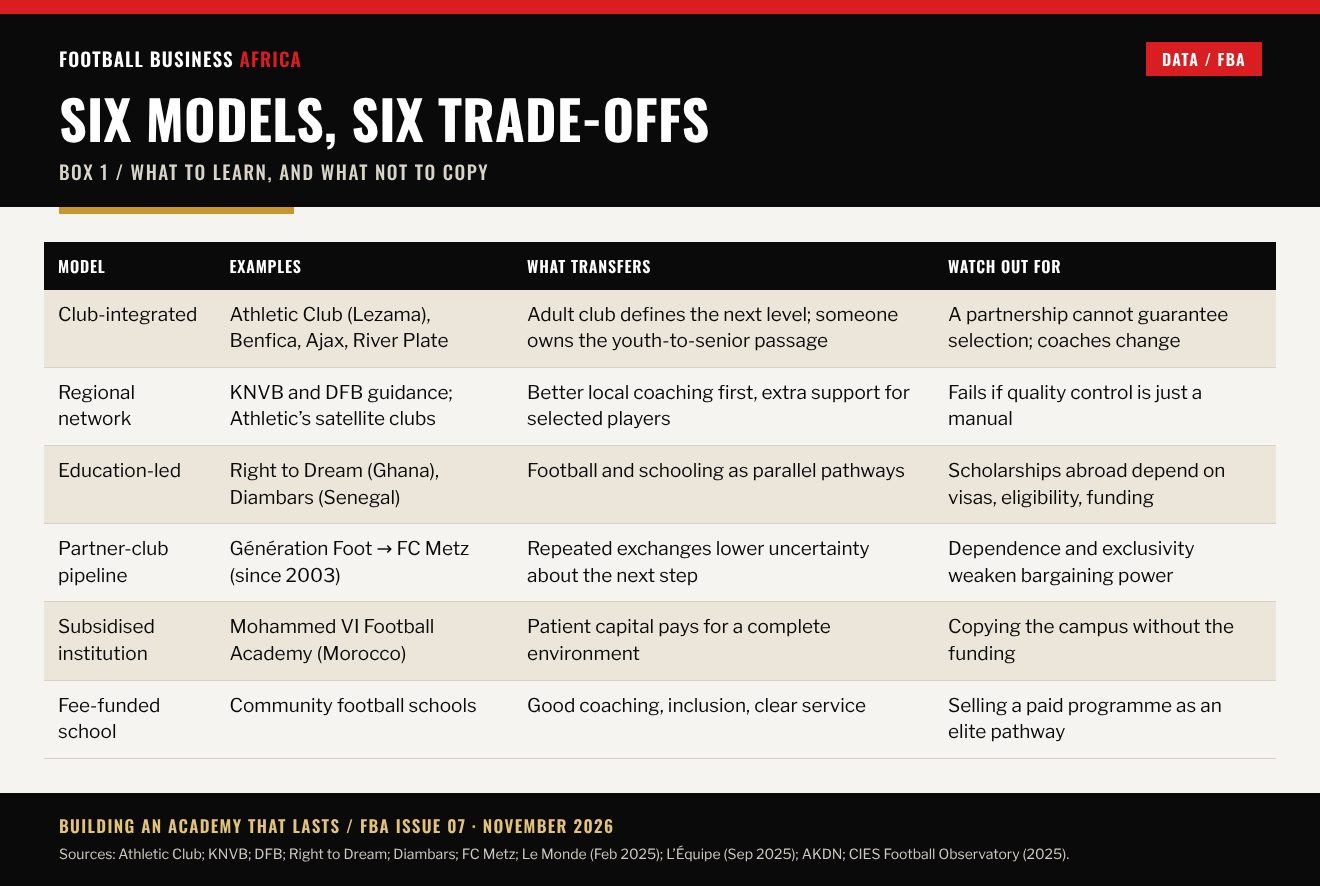
Six Models, Six Trade-offs
The world's productive academies do not share a single design. They share an architecture: a clear purpose, age-appropriate teaching, good coaches, regular games, individual support, education and welfare, a route into adult football, and an organisation funded to deliver all of it consistently.
The club-integrated system — Athletic Club's Lezama, Benfica, Ajax, River Plate — works because the adult team defines the next level and someone is accountable for the passage between youth and senior football. In Africa, the lesson is to partner with a credible adult club and agree progression reviews, while keeping alternatives if its coach changes. The regional network favoured by the Dutch and German federations improves local coaching and play first, then gives extra support to selected players without uprooting them from family and school. The education-led selective academy, exemplified by Right to Dream in Ghana and Diambars in Senegal, treats professional football and further education as parallel pathways.
The partner-club pipeline is best illustrated by Génération Foot and FC Metz, a relationship dating from 2003 that has taken 44 Senegalese players to Metz, according to Le Monde, and which L'Équipe reported in 2025 to be under strain. The subsidised institutional academy — Morocco's Mohammed VI Football Academy is the continent's flagship — shows what patient capital can pay for; copying the campus without the funding commitment produces a different, weaker model. And the fee-funded community football school is perfectly valid when it is honest about what it sells. Athletic Club's own website separates its commercial training camps from membership of its real youth structure, a distinction African academies flirting with European branding would do well to copy.
Why Academies Fail
Failure takes several forms: insolvency or investor withdrawal; survival without real development; abuse or educational harm; and impressive youth results that never become adult careers.
Field research on Red Bull's academy in Ghana, presented at Play the Game in 2015, pointed to geographic and institutional isolation, community and land conflicts, high player turnover and educational insecurity — despite excellent facilities. The site was later taken over by the West African Football Academy. In 2020, Ajax sold its 51% stake in Ajax Cape Town, a reminder that an international badge does not guarantee permanent backing. And reporting by The Times in 2025 on African teenagers sold a "European dream" and sent to the United Arab Emirates showed the darkest version of failure: a pathway sold without verification, legal status or support.
The warning signs are usually visible early: a beautiful facility alongside unpaid coaches; a budget that depends on an unsigned transfer; a founder who controls every function; the same physically early-maturing players dominating every age group; graduates who disappear after under-17 level; fee-paying parents influencing squad selection; education that exists only in brochures; and a child-protection policy no child could actually use.
If an academy cannot explain how it survives a year with zero transfers, it has not yet shown that it has an operating model.
What Happens on the Pitch
A credible academy starts with a development promise that changes daily decisions — for instance: we develop adaptable footballers who can perceive, decide and act under pressure, care for themselves and others, and progress in education as well as football. A 4-3-3 can organise those ideas, but a formation is not a methodology.
The Dutch federation's approach — keep the game in training, present a real football problem, make it feel like play — and Germany's emphasis on small-sided games point the same way: more decisions per child, less standing in queues. Assessment should be repeated, in different roles and contexts, not a single trial day. The Dutch federation explicitly warns that early selection channels better coaching towards children who are already ahead, often simply because they were born earlier in the year or matured sooner.
Off the pitch, schooling has to be a staffed function, not a promise. Child protection must be something children can use: background checks, rules for travel, changing rooms and digital contact, and a reporting route that does not run through the coach. FIFA's Guardians programme and the safeguarding toolkit CAF launched in February 2026 provide starting points. The risk is real: in October 2026, The Guardian reported that a coach banned by FIFA for sexual abuse had continued to train children in Kinshasa. Girls' programmes need safe transport, suitable facilities and women staff — not a publicity line in the boys' budget.
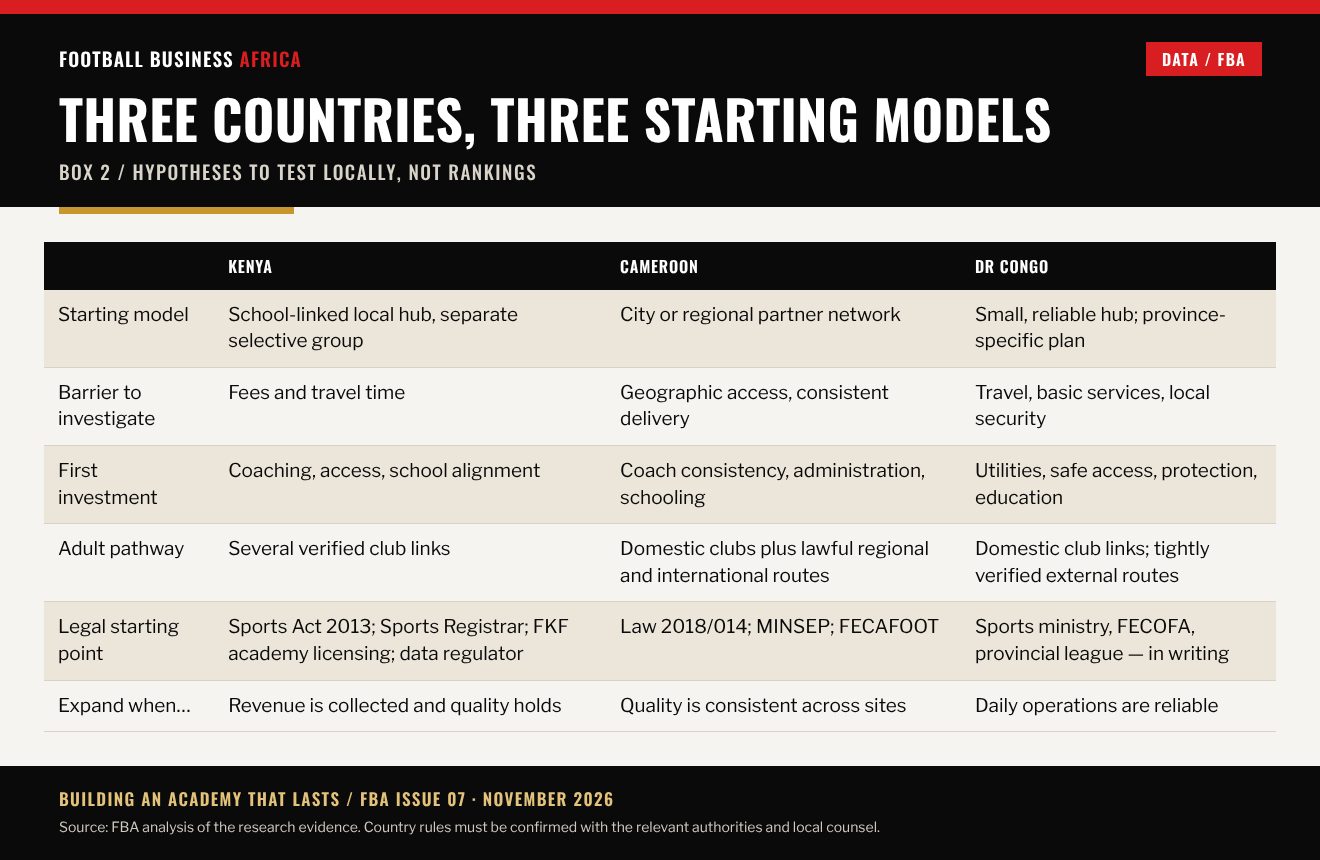
Kenya, Cameroon, DR Congo
Africa is not one operating market, and neither is any single country. A Nairobi suburb, a Douala neighbourhood and a peri-urban site in Kinshasa need different plans. Still, the evidence suggests a sensible default for a new founder: a locally anchored, non-residential academy linked to schools and adult clubs, with a separately funded selective pathway. Boarding should come later, when the need and the operating capacity are proven. A purpose-built campus is an investment decision, not the definition of an academy.
In Kenya, that means a school-linked hub in a defined catchment, with paid places where families can afford them and ring-fenced scholarships. Founders should check travel times at training hours, written pitch access and a verified competition calendar. Company registration is not football authorisation: the Sports Registrar operates under the Sports Act 2013, the Football Kenya Federation licenses academies, and Kenya's data regulator has specific guidance on children's data.
In Cameroon, a regional network anchored in one city, with partner schools and community coaches working to a shared curriculum, makes more sense than a single flagship. The 2018 sports law is the starting point, but no complete, current academy-permit checklist is publicly available; written clarification from the sports ministry, FECAFOOT and local authorities is essential. Trustworthy identity and registration records will matter as much as coaching.
In DR Congo, begin small in a manageable catchment, with verified land rights, safe access, water, power and emergency care built in. A Kinshasa plan is not a national plan. The government's partnership with AS Monaco is a capability-building opportunity, not a funding stream or a guaranteed pathway.
The Money
An academy has four kinds of football income, and they are not interchangeable. Participation fees pay for a service. Transfer fees depend on a lawful transfer and the academy's actual legal and sporting position. Training compensation and the solidarity contribution are regulatory rewards paid under FIFA rules — and only to registered clubs that can prove a player's training history. Under the solidarity mechanism, 5% of a qualifying $1 million transfer creates a $50,000 pool shared among all eligible training clubs. It is not an academy commission, and it is not annual income.
Nor is exporting minors a business model. FIFA's rules generally prohibit international transfers of players under 18, with narrow exceptions; a parent's consent, a visitor visa or a private agreement does not change that.
FBA modelled an illustrative non-residential academy: 120 players, 90 paying and 30 on scholarships, with annual running costs of $80,000 — coaching, pitch access, administration and safeguarding, health and insurance, competition and transport, education support and a contingency. At $500 a year per paying family and a 90% collection rate, fees bring in $40,500. A committed sponsor adds $25,000 and camps another $8,000. The result is a $6,500 gap before any capital spending. Breaking even on fees alone would require about $580 per family, which may be more than the catchment can afford. Lose the sponsor, and the gap becomes $31,500. These are planning figures, not local prices — but the logic holds anywhere.
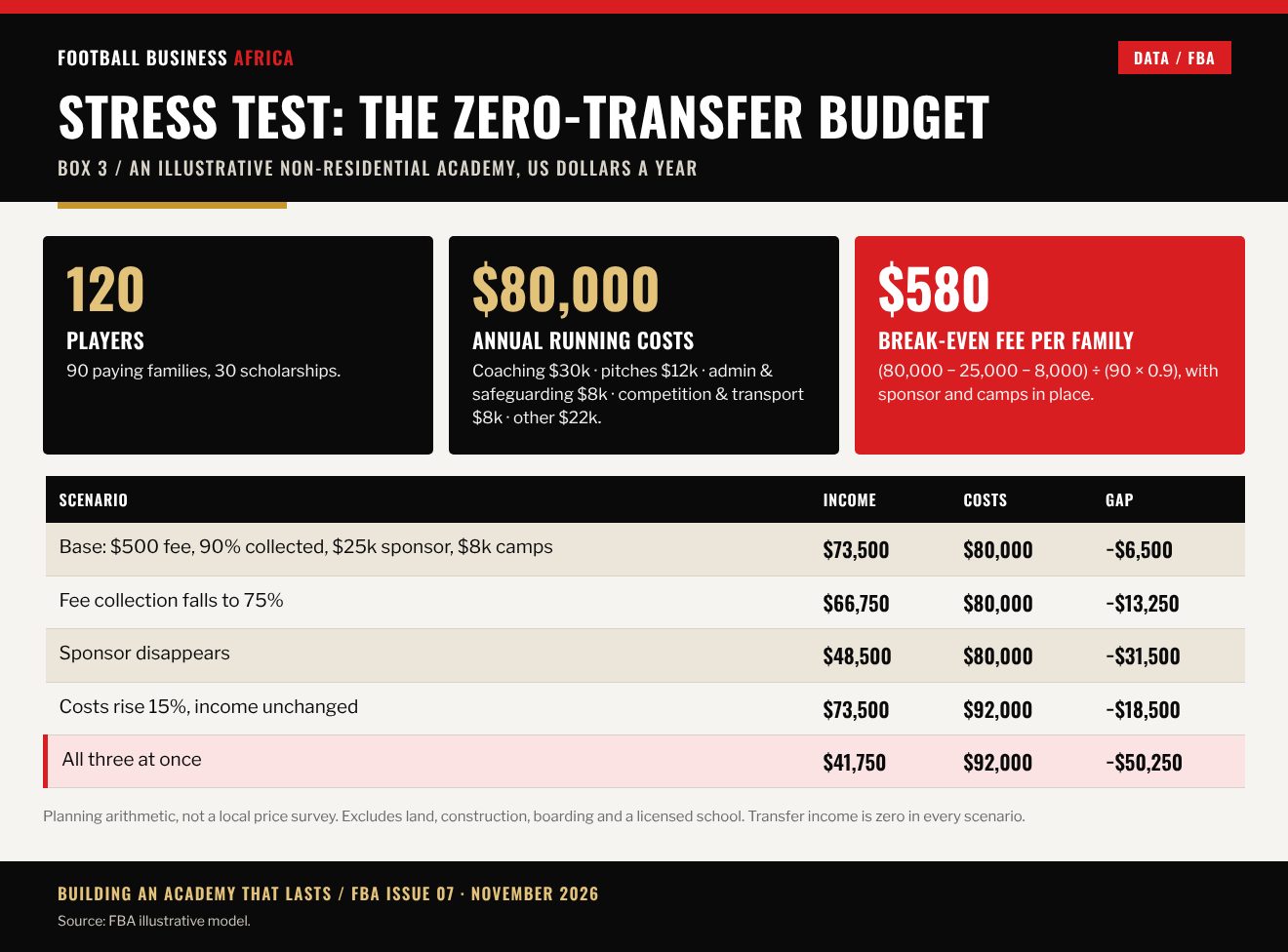
Boarding changes everything. Even a hypothetical $2,000 per resident a year for food, accommodation and welfare means $80,000 for a cohort of 40 — before coaching, schooling, travel or medical care. A donated building does not remove those obligations. Founders should fund the first full operating year and an emergency reserve before opening, keep scholarship money separate from general cash, and write a closure plan that protects the children already enrolled.
The Bottom Line
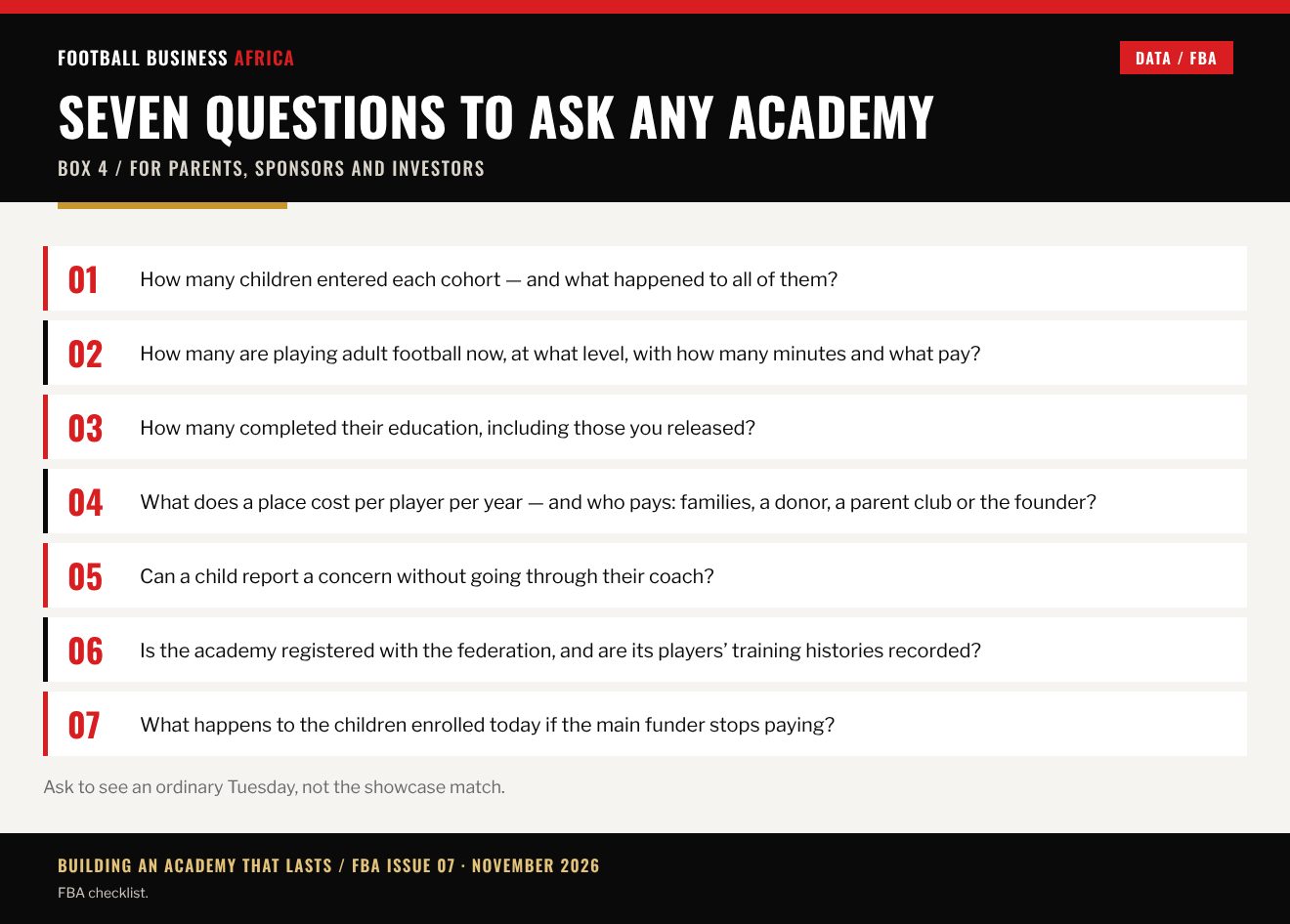
Africa does not lack academies. It lacks academies that can show their work: how many children came in, what happened to all of them, what each place costs and who pays when a sponsor leaves.
The most durable model for most founders is not a glossy campus selling a route to Europe. It is a well-run local football school, a separately funded scholarship pathway, real games every week, protected schooling, and documented links to adult clubs — built to survive a year without a single transfer.
That is less glamorous than a star graduate. But it is how African football keeps more of the value it creates — and how families can tell a pathway from a promise. Before trusting any academy, ask to see an ordinary Tuesday, not the showcase match.
Sources & further reading
- 01
Kinshasa — Actualite.cd
120 Congolese coaches complete the first RDC–AS Monaco workshop, 15 October 2026. Read the source
- 02
FIFA — Global report: Give every talent a chance
The worldwide baseline: 205 member associations, 864 academies. Read the source
- 03
Verbeek et al. — systematic review of talent development
International Review of Sport and Exercise Psychology: 85 studies. Read the source
- 04
Dugdale et al. — progression from youth to professional football
537 players, 12 years, 53 professional contracts. Read the source
- 05
CIES Football Observatory — best football academies, 2025
Benfica, Barcelona and River Plate at the top. Read the source
- 06
UEFA — Club Licensing Regulations 2025, Article 19
Youth development programme requirements. Read the source
- 07
CAF — Men's Club Licensing Regulations
Youth programme, staff, schooling and medical requirements. Read the source
- 08
Athletic Club — Lezama and its network
The club-integrated model in its own words. Read the source
- 09
KNVB — football vision and equal opportunities
Dutch federation guidance on learning and early selection. Read the source
- 10
Le Monde — FC Metz, springboard for Senegalese players
The Génération Foot pipeline, February 2025. Read the source
- 11
Play the Game — Red Bull Ghana
Martin Kainz's fieldwork presentation, 2015. Read the source
- 12
Ajax — sale of Ajax Cape Town shares
September 2020. Read the source
- 13
CAF — Safeguarding Toolkit
Launched under CAF IMPACT, February 2026. Read the source
- 14
FIFA — Guardians safeguarding guidance
The implementation framework. Read the source
- 15
FIFA — Guide to submitting a minor application, 2026
The rules on international transfers of under-18s. Read the source
- 16
FIFA — Clearing House regulations
Training compensation and the solidarity mechanism. Read the source
- 17
Kenya — Registrar of Sports
The statutory mandate under the Sports Act. Read the source
- 18
Cameroon — Law 2018/014 on sport
Presidency of Cameroon. Read the source
- 19
Further reading — FBA, The Dream Factory
How Right to Dream built a global football business. Read on FBA
Dollar conversions are approximate, at the exchange rate at signing where known and otherwise at 2026 rates. Figures marked "reported" come from press reports rather than official disclosures.