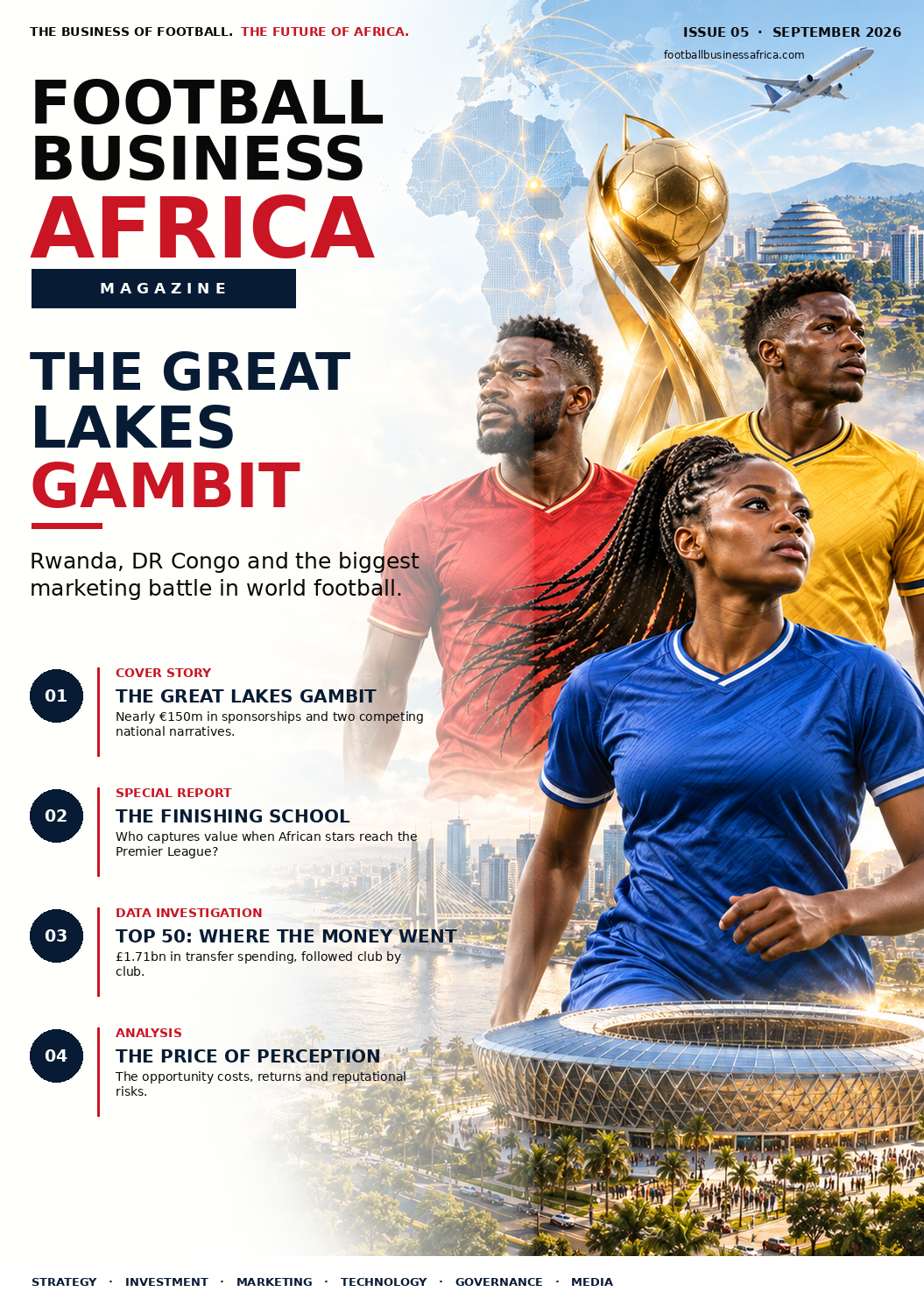
For eight seasons, from 2018 until June 2026, three words on Arsenal's sleeves turned Premier League broadcasts into a global tourism campaign: "Visit Rwanda." The partnership has now ended, but it helped establish a model that continues elsewhere.
In Paris, the same slogan remains attached to Paris Saint-Germain under a renewed agreement running through 2028, alongside an academy in Rwanda and promotional activity built around tourism, culture and products.
In Barcelona, a four-year agreement says the Spotify Camp Nou will host a "House of the DRC"—a cultural and sporting showcase for the Democratic Republic of Congo—while Barça's professional teams carry the "R.D. Congo – Coeur d'Afrique" identity on training wear.
These scenes represent the unlikely convergence of European football's global stage and Central Africa's most complex geopolitical rivalry.
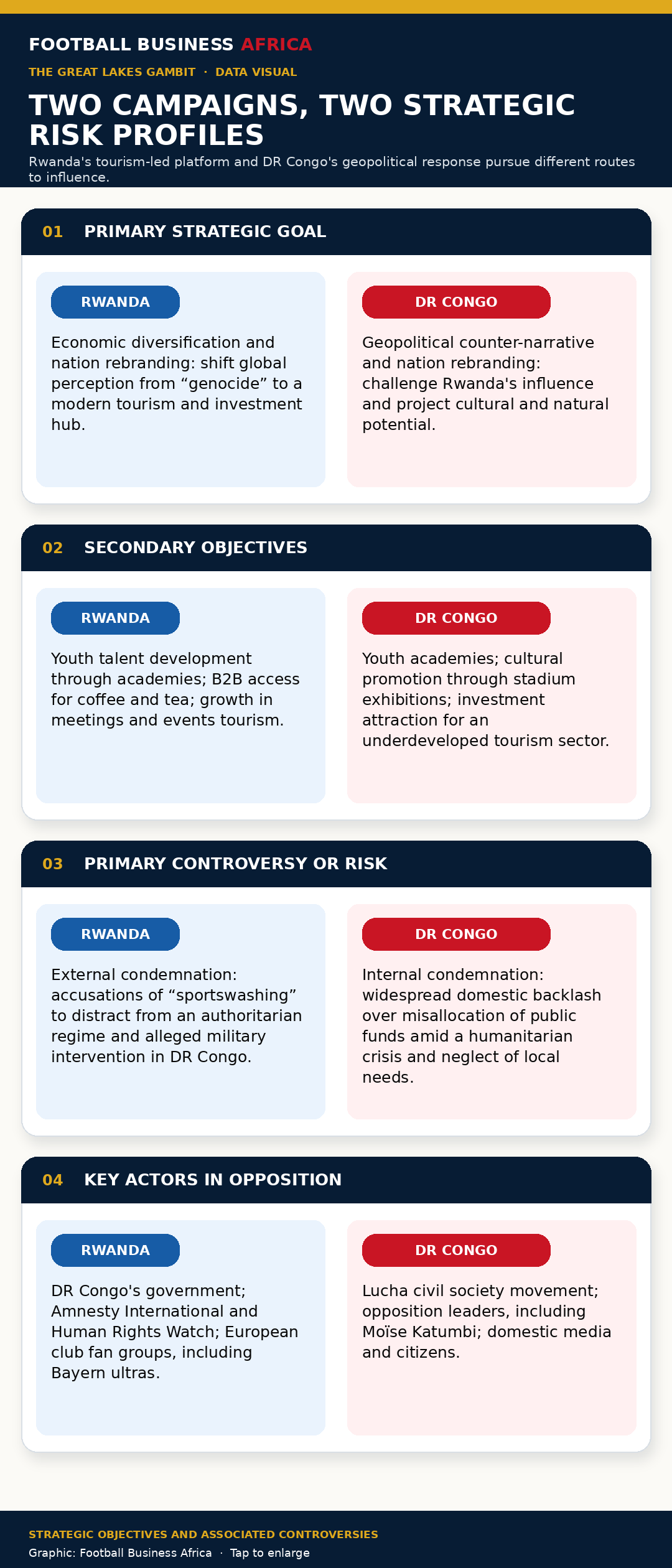
What began as Rwanda's pioneering €40 million-per-year gamble to rebrand itself through football has triggered a high-stakes marketing arms race with its much larger neighbor.
The DRC's recent €90 million counter-offensive across three European giants—FC Barcelona, AC Milan, and AS Monaco—has transformed football shirts into billboards for competing national narratives, turning the beautiful game into a proxy battlefield for soft power projection.
This is more than sports sponsorship—it's nation-branding as geopolitical chess, where every goal scored wearing these logos carries the weight of historical trauma, regional conflict, and aspirational futures.
For Rwanda, it's about escaping the shadow of genocide to emerge as Africa's Singapore. For the DRC, it's about asserting its vast potential while challenging what it sees as Rwanda's carefully crafted international deception. Together, these campaigns represent nearly €150 million in African state funds flowing into European football—a phenomenon that would have been unthinkable a decade ago and raises profound questions about development priorities, marketing effectiveness, and the evolving nature of international influence in the 21st century.
The Architecture of Ambition
Rwanda's entry into European football sponsorship was neither impulsive nor accidental.
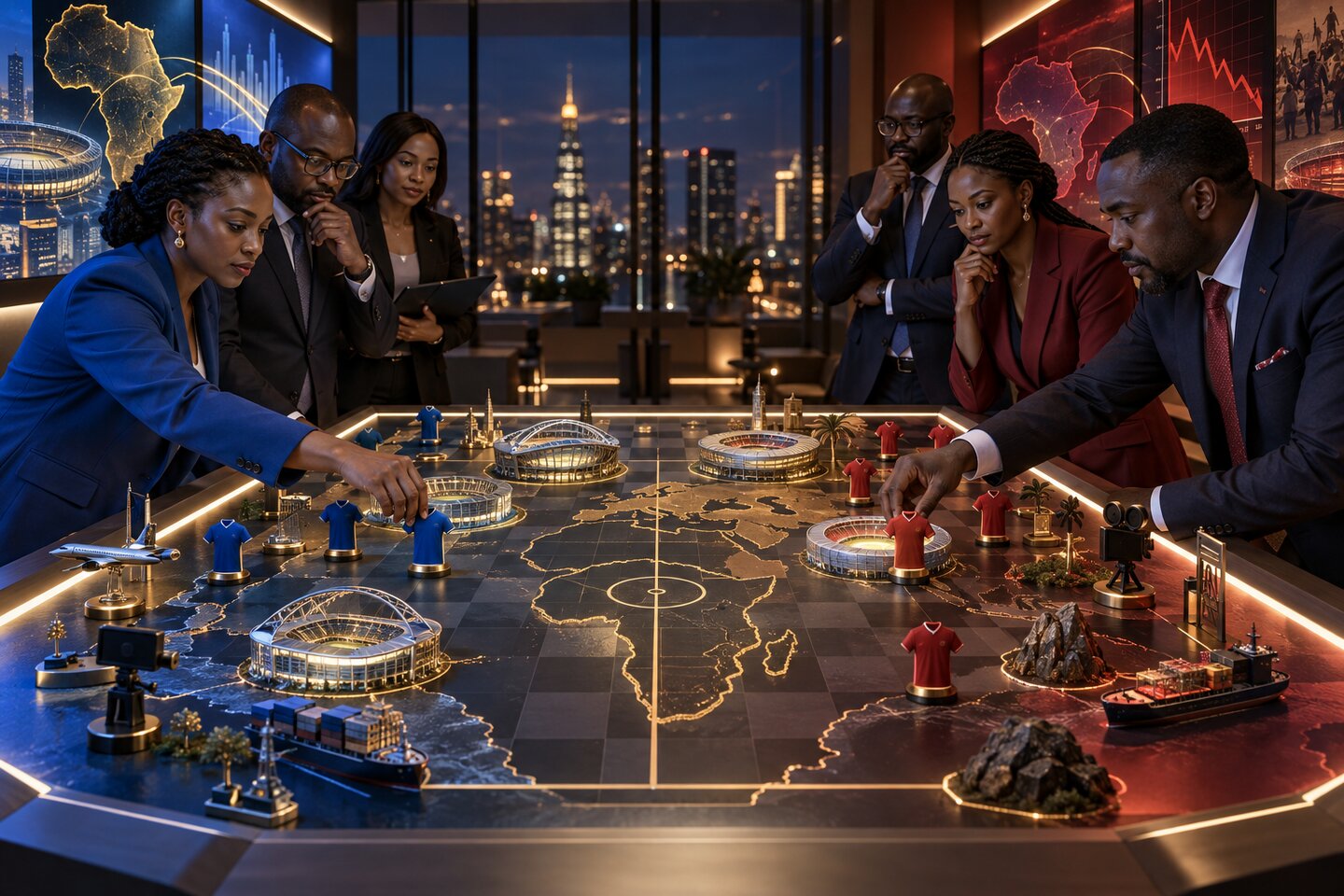
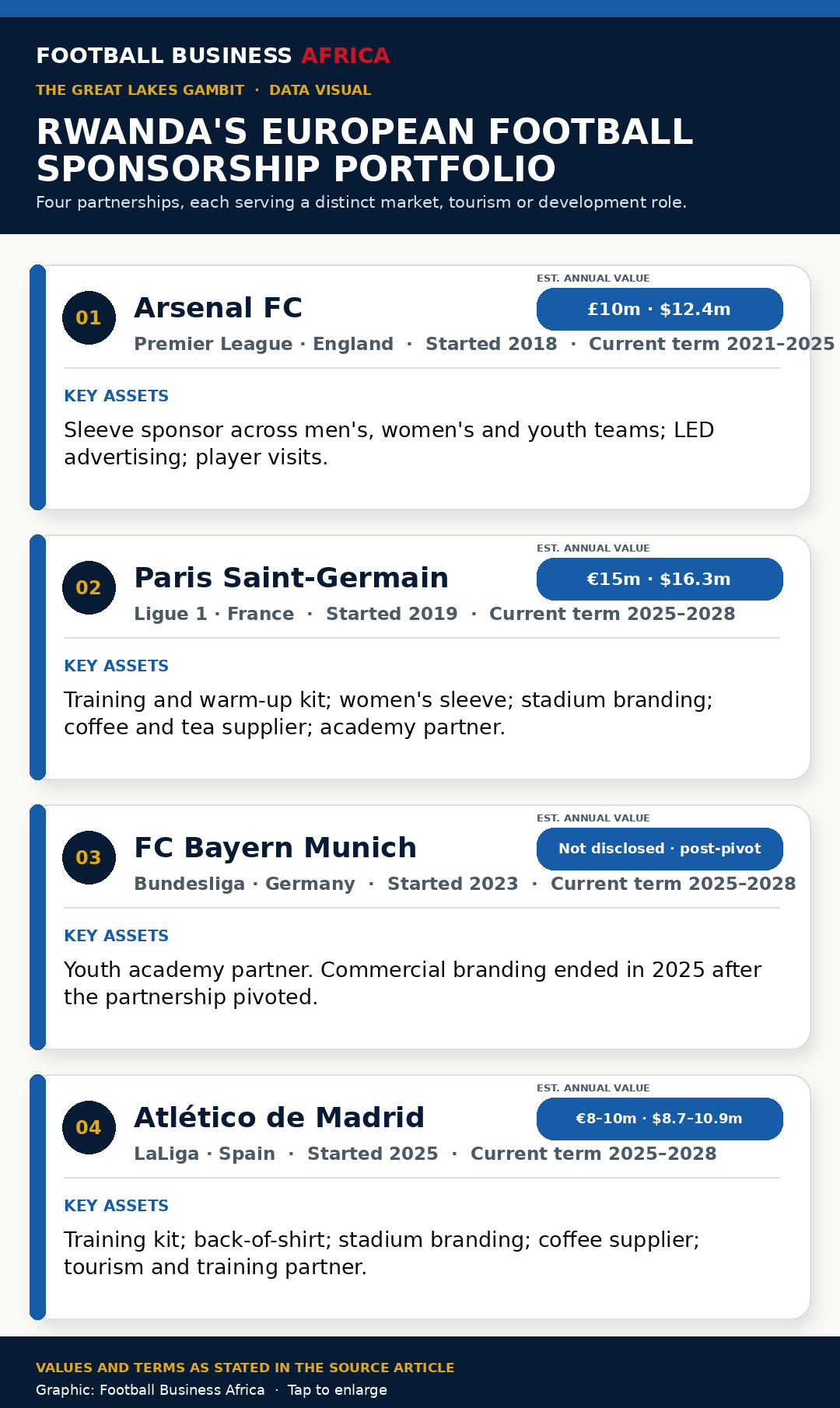
Rwanda's European-football strategy took shape in 2018 under the Rwanda Development Board, then led by Clare Akamanzi. The Arsenal launch made Visit Rwanda the club's official tourism partner and first sleeve partner: a deliberate attempt to associate the country with a global, contemporary sporting platform.
Rwanda presents the strategy as a long-term investment in awareness, tourism and market access. The available record clearly establishes the scale and duration of the club relationships; it is less conclusive about causation. Tourism performance, media exposure and sponsorship activity may move together, but public figures do not isolate how much growth any single football partnership produced.
The sophistication of Rwanda's approach becomes apparent in its portfolio diversification. Each partnership serves a distinct strategic purpose: Arsenal provides Premier League glamour and global reach; Paris Saint-Germain offers access to French-speaking markets and luxury branding; Bayern Munich (before fan protests forced a pivot) brought German efficiency and commercial prowess; Atlético Madrid opens doors to Spanish-speaking audiences and Latin American markets.
But it's the integration that sets Rwanda apart. PSG players don't just wear the logo—they drink Rwandan coffee in hospitality suites. The club runs an academy in Huye that has trained over 400 young Rwandans. Arsenal legends make promotional visits to Volcanoes National Park. This isn't passive advertising; it's active narrative construction.
The Heavyweight Responds
The DRC's entry into football sponsorship reads like a geopolitical thriller. In late 2024, Foreign Minister Thérèse Kayikwamba Wagner dispatched letters to Arsenal, PSG, and Bayern Munich, urging them to sever their "bloodstained" partnerships with Rwanda, citing UN reports of Rwandan support for M23 rebels in eastern Congo. When the clubs demurred, Kinshasa decided to fight fire with fire.
DR Congo's answer moved from criticism to competing visibility. Official club announcements frame the new partnerships around tourism, youth development, culture and the "Heart of Africa" identity. At AS Monaco, Sports Minister Didier Budimbu publicly described the programme as a broad plan to build sporting industries, jobs and opportunity for young people.
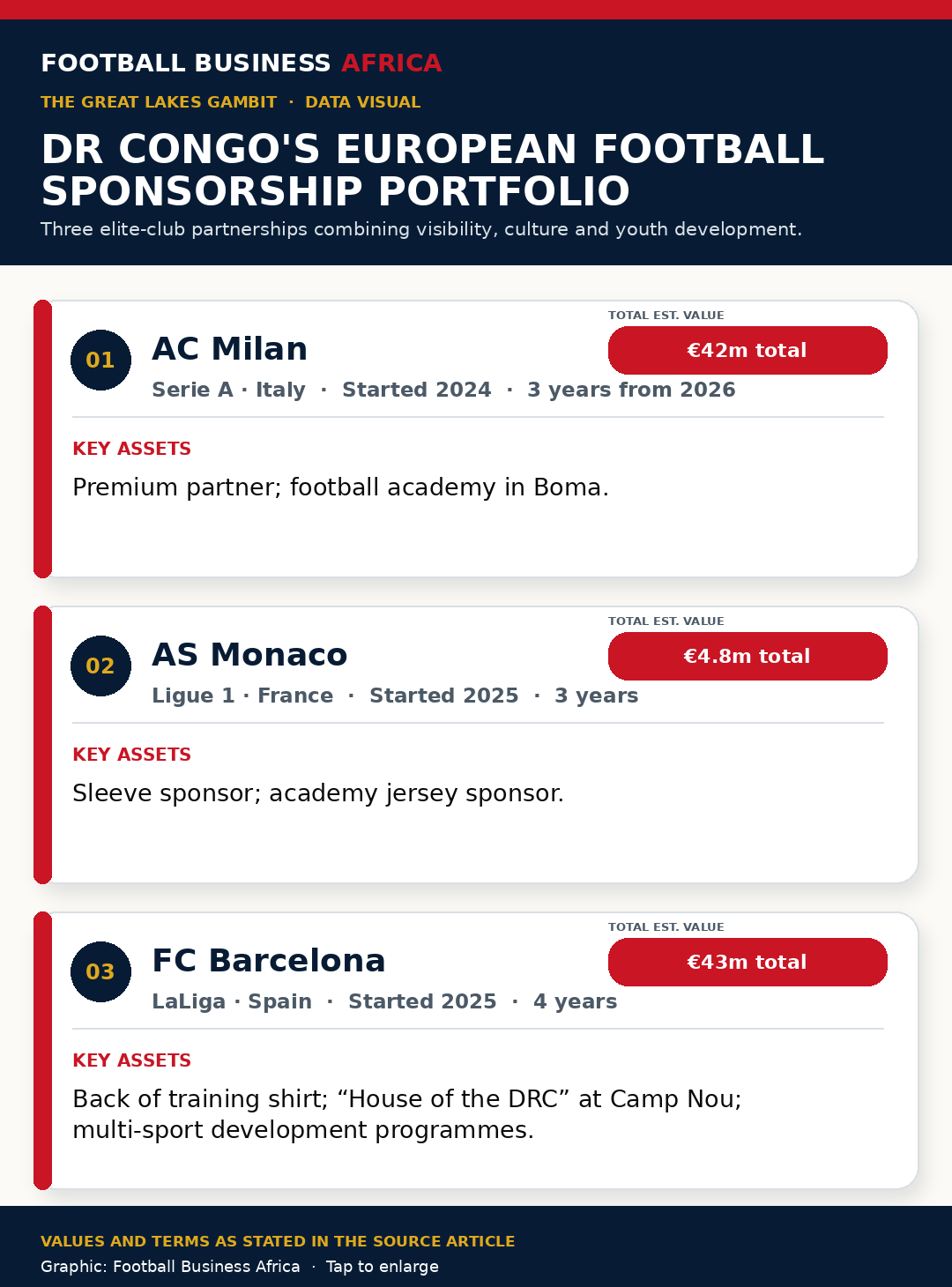
The speed and scale of the DRC's response has been striking. Within weeks in 2025, official announcements linked the country to AC Milan, AS Monaco and FC Barcelona. Published estimates put the combined commitments at roughly €90 million, although the clubs' own releases describe programmes and terms more readily than full financial detail.
The Barcelona deal alone—€43 million over four years—includes unprecedented elements. Beyond traditional shirt sponsorship, it encompasses multi-sport development programs, cultural exhibitions, and the ambitious "House of the DRC" at Camp Nou. This isn't just advertising; it's an attempt at cultural diplomacy on steroids.
Yet the DRC's campaign faces a fundamental challenge that Rwanda's does not: product-market fit. Rwanda has spent years packaging conservation, hospitality and high-value tourism. The DRC offers extraordinary potential—rainforests, biodiversity, minerals and culture—but must market that promise alongside conflict in the east, weak infrastructure and a far less mature tourism offer.
The Price of Perception
The contrasting domestic reactions to these campaigns reveal their deepest vulnerabilities. In Rwanda, where media control is tight, the sponsorships are largely portrayed as savvy investments in national development. President Kagame, himself an avowed Arsenal fan, personally promotes the partnerships on social media.
In the DRC, the response has been contentious. Critics have questioned the opportunity cost of paying for elite-club visibility while the country faces conflict, displacement and pressure on basic services. Supporters answer that the agreements also promise academies, training, cultural promotion and international market access. That disagreement—advertising spend versus development platform—is central to judging the campaign.
The financial mathematics are stark. Rwanda's annual sponsorship spending of approximately €45 million represents about 0.4% of GDP—significant but manageable for a country with steady growth and improving fundamentals. The DRC's €90 million commitment represents a similar GDP percentage, but in a nation facing humanitarian crises, it reads differently.
Lessons from the Gulf
The Rwanda-DRC rivalry offers a fascinating African parallel to the Gulf states' sports investments, but with crucial differences. Qatar's €200 million annual spend on PSG or Saudi Arabia's £650 million Newcastle United takeover dwarf these African investments. But relative to national wealth, Rwanda and the DRC are playing an even higher-stakes game.
The comparison with Gulf-state sports investment is useful but imperfect. In each case, football buys international attention and relationships; for Rwanda and the DRC, however, the spending is larger relative to national resources and the development case is therefore more exposed to scrutiny.
The effectiveness metrics also diverge. Qatar's World Cup hosting, despite controversy, delivered 1.5 million visitors and $17 billion in economic impact. Rwanda's tourism growth, while impressive, remains modest in absolute terms. The DRC hasn't yet seen measurable returns on its investments.
The Wider African Context
Rwanda and the DRC aren't alone in recognizing football's soft power potential. Nigeria has explored Premier League partnerships, Kenya has targeted Formula One, and South Africa continues leveraging its 2010 World Cup legacy. But the intensity and expense of the Rwanda-DRC rivalry remains unique.
What makes the rivalry unusual is that these are not ordinary commercial sponsorships. They are public-policy statements whose return must ultimately be measured in influence, tourism, investment, skills and opportunity—not only in advertising impressions.
These are public-policy statements with returns measured in influence, investment and opportunity — not only impressions.
The opportunity-cost debate is unavoidable. Every euro committed to international marketing is a euro that must be justified against urgent domestic needs. The strongest defence of nation branding is that changed perceptions can unlock tourism and investment; the strongest objection is that exposure is not the same as measurable public benefit.
The Sustainability Question
As these campaigns mature, fundamental questions about sustainability emerge. Rwanda's model has evolved since 2018: PSG renewed through 2028, while Arsenal and Visit Rwanda mutually ended their partnership in June 2026 after eight seasons. The controversy around the deals demonstrates that fan activism, conflict and human-rights scrutiny can reshape even well-established commercial relationships.
The DRC's campaign, barely a year old, faces even steeper challenges. The domestic backlash threatens political support, the funding sources remain opaque, and the gap between marketed image and ground reality could prove unbridgeable.
The measurement challenge compounds the sustainability question. While Rwanda points to tourism growth and media metrics, establishing causation versus correlation remains difficult. Did visitors come because of Arsenal, or would growth have occurred anyway? The DRC, sources tell FBA, lacks baseline metrics to assess impact.
Looking Forward: The End Game
The Rwanda-DRC football rivalry represents more than regional competition—it's a test case for whether developing nations can successfully leverage sports marketing for transformation. The stakes extend beyond Central Africa; success or failure will influence how other emerging nations approach soft power projection.
For Rwanda, the challenge is managing the growing disconnect between its marketed image and political reality. For the DRC, the challenge is even more fundamental: Can marketing create reality, or must reality precede marketing? The country's bet that improved perceptions will drive investment and development inverts traditional development logic. It's a supply-side approach to nation branding—build the image first, hope the substance follows.
Can marketing create reality, or must reality precede marketing?
The European clubs, meanwhile, face their own reckoning. As African states emerge as significant sponsors, football must grapple with its role in international politics. The beautiful game has always been political, but the Rwanda-DRC rivalry makes that politics impossible to ignore.
The Beautiful Game's Ugly Questions
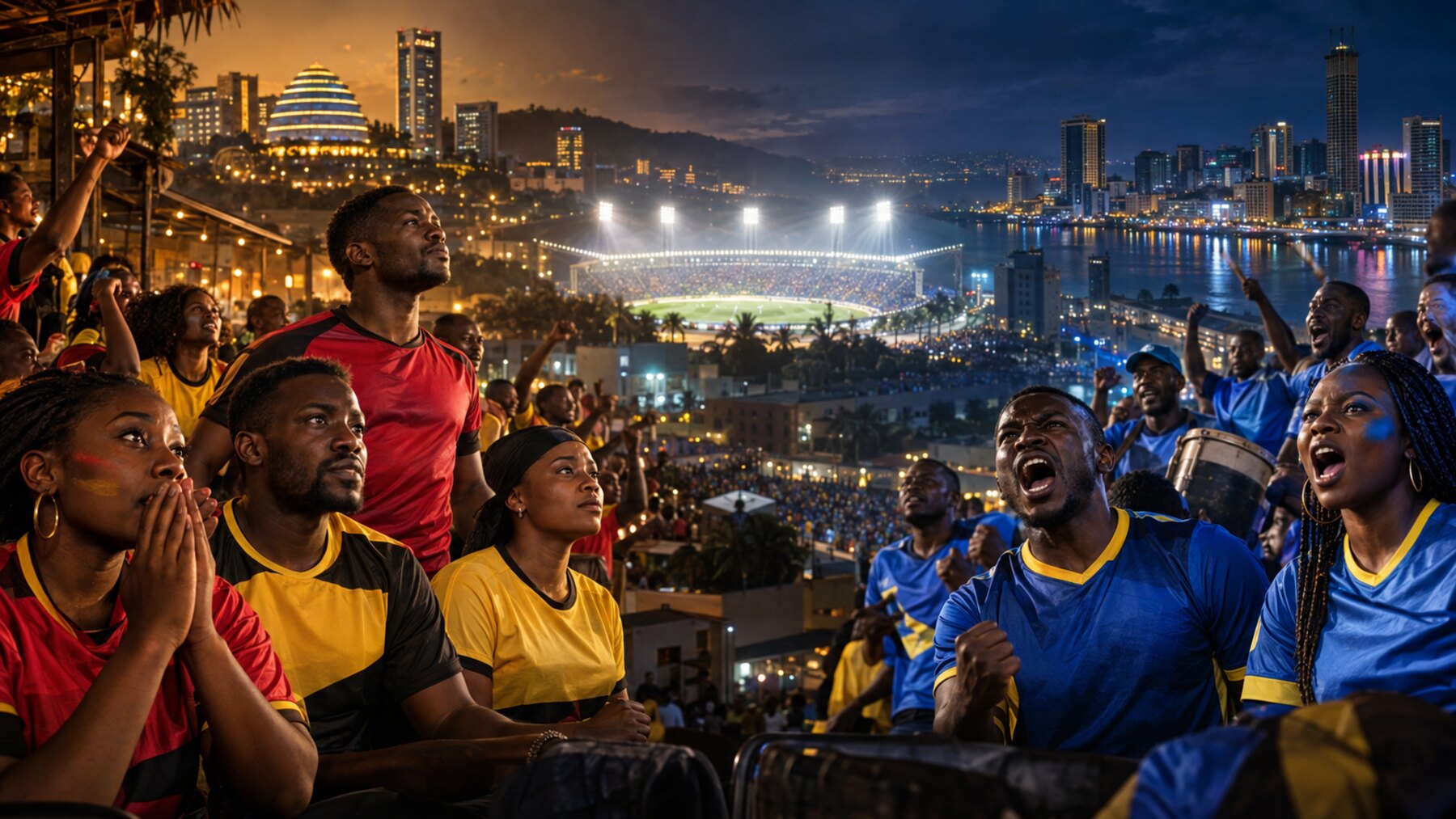
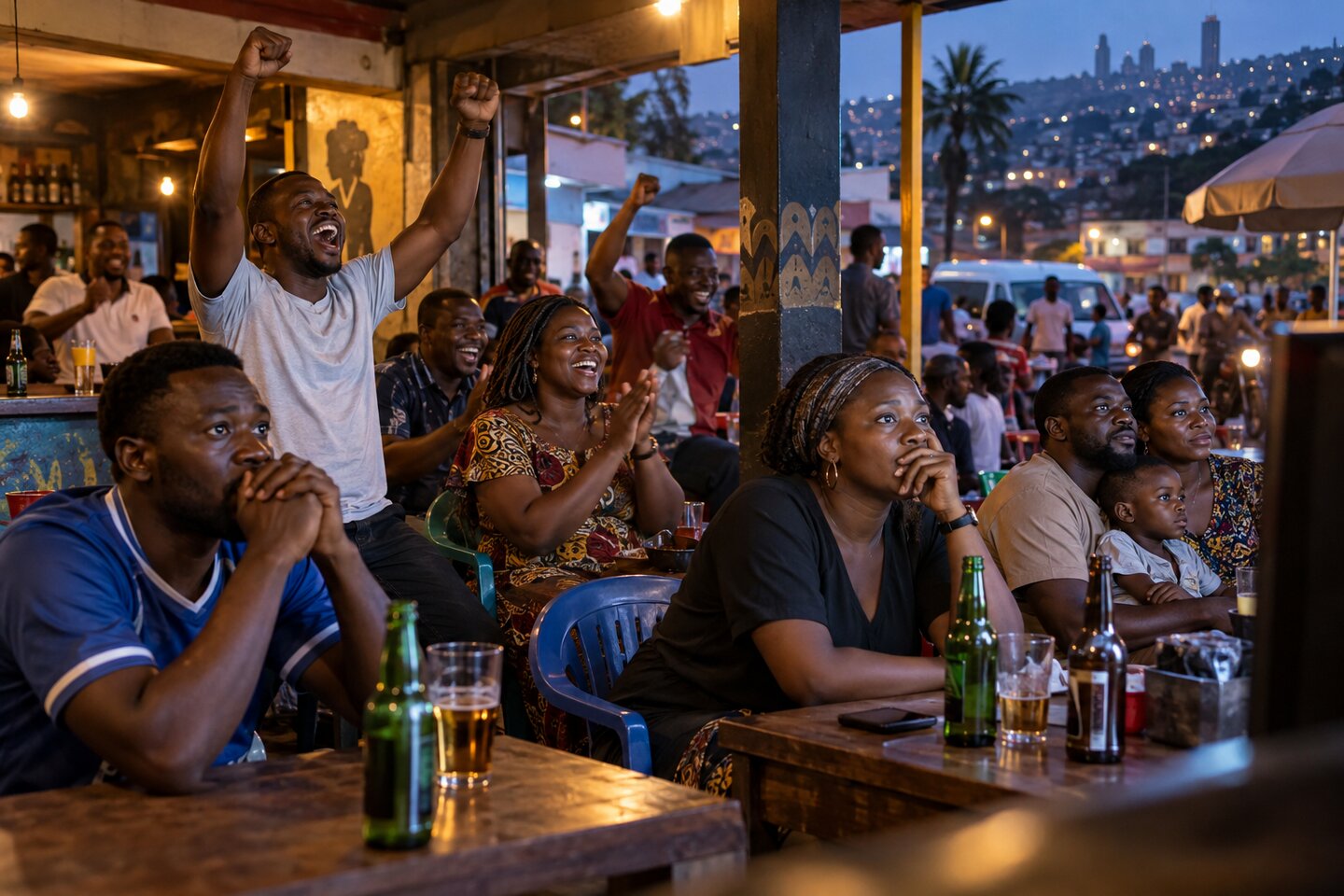
As evening falls over Kigali and Kinshasa, young men gather in neighborhood bars to watch European football on satellite television. They cheer for Arsenal and Barcelona, PSG and Milan, their loyalties now tinged with national, perhaps, pride or embarrassment. The jerseys they can't afford to buy carry their countries' names into living rooms and stadiums worldwide.
This is the ultimate paradox of the Great Lakes football war: two nations spending fortunes to impress foreigners while their own citizens watch from afar. It's development strategy as performance art, where the audience matters more than the actors.
Two nations spending fortunes to impress foreigners while their own citizens watch from afar.
The effectiveness of these campaigns won't be measured in goals scored or trophies won, but in tourists arrived, investments secured, and narratives changed. Rwanda has a head start, better organization, and clearer product-market fit. The DRC has scale, potential, and the moral high ground of victimhood.
Both are betting that football can achieve what traditional diplomacy cannot: making the world care about Central Africa for reasons beyond tragedy. It's an expensive gamble, a controversial strategy, and a fascinating experiment in 21st-century statecraft.
The argument is therefore not simply whether football visibility is good or bad. It is whether governments publish clear costs, define outcomes in advance and report independently verifiable results—so citizens can judge whether reputation spending produces public value.
In this contest between aspiration and reality, between image and substance, between two nations locked in rivalry, football has become the unlikely arbiter. The beautiful game may not resolve Central Africa's complex challenges, but it has certainly made them impossible to ignore.
The final score in this match remains unwritten. But with nearly €150 million already committed and millions of global fans now unwitting participants, one thing is certain: the Great Lakes gambit has transformed African football sponsorship from curiosity to serious business. Whether that business delivers development or merely distraction remains the billion-dollar question.
Sources & further reading
Public documents and reporting used to verify the article. Links open the original source.
- 01
Reuters: DRC asks clubs to end Visit Rwanda deals
- 02
Reuters: Rwanda responds to criticism
- 03
Rwanda Development Board: PSG renewal
- 04
FC Barcelona: DRC partnership
- 05
Le Monde: reported deal values and debate
Published by Football Business Africa · 22 September 2026.