This week, the FIFA World Cup returns. For a few extraordinary weeks, football will once again become the world’s common language. Stadiums will fill, television audiences will reach into the billions, and African players will once again stand among the defining figures of the tournament. But this issue of Football Business Africa asks a different question. What happens after the final whistle?
The paradox of abundance
Walk through the world’s elite leagues on any given weekend and Africa’s imprint on football becomes impossible to ignore. African players are among the world’s most valuable assets. Yet Africa’s football economy remains comparatively small. European clubs scout Africa early, develop talent within stronger systems, and monetise it through transfers, sponsorships, media rights and global branding. Africa produces talent. Others industrialise it.
Many African leagues, meanwhile, wrestle with limited broadcasting revenues, fragile sponsorship ecosystems, inconsistent governance and infrastructure deficits. Africa produces football value at scale while capturing only a fraction of the industry built around it.
Where Africa loses value
There are four invisible leaks in football’s global economy. The first is cheap talent and expensive outcomes: many African clubs sell early because they must, and by the time a player becomes a €50 million or €100 million asset, the ecosystem that first developed him may have captured only a small fraction of the final transfer value.
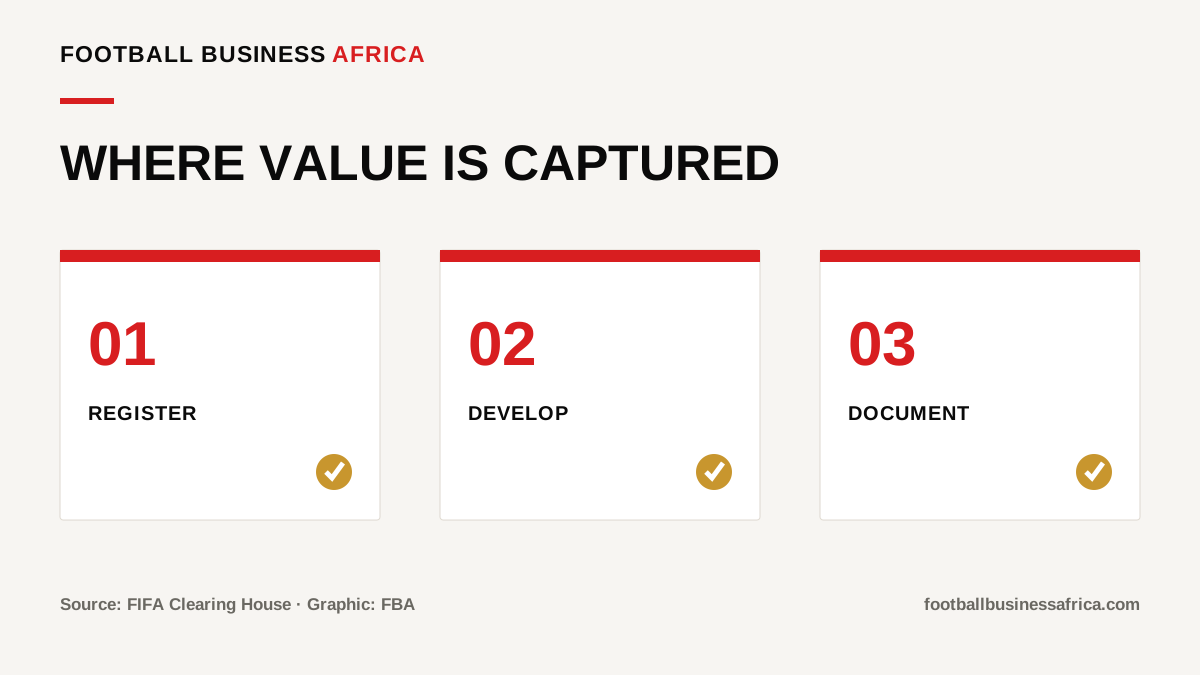
The second is FIFA’s training-compensation puzzle. The mechanisms were designed to reward development, but poor documentation, weak administration and limited legal capacity mean many clubs cannot receive what they are entitled to. The third is football without broadcast money: most African leagues struggle to secure stable TV deals, and without media revenue, commercial growth and investment remain out of reach. Passion is abundant; monetisation is not.
The fourth leak is the invisible footballer. Many players lack digital identities, performance records or standardised data. Talent without proof struggles to become capital. Across the value chain — from local academy to early transfer abroad, to elite transfer and global commercial monetisation — value grows exponentially, but the leaks ensure that the original African club captures the least.
Millions of dollars in compensation exist within the system. The challenge is accessing them.
FIFA compensation and the invisible footballer
FIFA’s solidarity and training-compensation mechanisms were created to ensure those who develop players share in the rewards. The reality is that many African clubs lack the systems, records and legal support to claim what they are entitled to. The cost is millions of dollars in potential revenue never recovered — money that could have built facilities, employed staff and developed the next generation. The challenge for many African clubs is a combination of incomplete records, weak administrative systems, limited legal support and uneven enforcement.
Who profits from African football?
There are many winners, and many responsibilities. Elite clubs with patience can invest time and resources to develop players and monetise them when value peaks. Some governments understand football as industry, not just entertainment: Rwanda’s partnerships with Arsenal, PSG and Atletico Madrid aim to use football as a tool for tourism, international branding and investment attraction. Supporters call it soft power; critics call it expensive branding. Either way, the lesson is clear — this is a global imbalance, but it is also a domestic systems problem.
How Africa could win more
Football’s future will belong not only to those who produce talent, but to those who build systems around it. Africa already has football’s most abundant resource: talent. The challenge is to capture more of the value it creates, and five priorities emerge — make athletes visible, stop leaving FIFA money on the table, build stronger domestic economies, invest in data without losing human judgement, and think regionally rather than only nationally.
The best systems combine intuition and analytics — better scouting tools, performance analytics, medical monitoring and video intelligence. And scale creates leverage: shared media rights, regional competitions, cross-border academies, common standards and collaborative digital platforms mean larger markets, greater visibility and stronger bargaining power.
After the World Cup
When the final whistle blows at the 2026 FIFA World Cup, African players will once again have helped shape football’s greatest spectacle. Some will leave as global stars; transfer valuations may rise; new sponsorships will emerge. The football economy will continue to move. The deeper question is whether Africa itself will move with it.
Africa does not suffer from a shortage of football genius. Its challenge is institutional, economic and structural. Potential inspires; institutions create value. The next chapter depends on a profound shift — from seeing football primarily as sport, to understanding it also as industry. Ecosystems connect academies to clubs, players to data, supporters to platforms, football to investment. They think in decades, not in transfer windows. The answers to who owns football’s stories, its data, its markets and its future will determine whether Africa remains a supplier — or becomes one of football’s architects.
Sources & further reading
Public documents and reporting used to verify the article. Links open the original source.
- 01
FIFA Clearing House regulations
- 02
FIFA Training Rewards Calculator
- 03
FIFA Global Transfer Reports
- 04
FIFA Football Tribunal
Originally published in Football Business Africa, Issue 04 · June 2026.