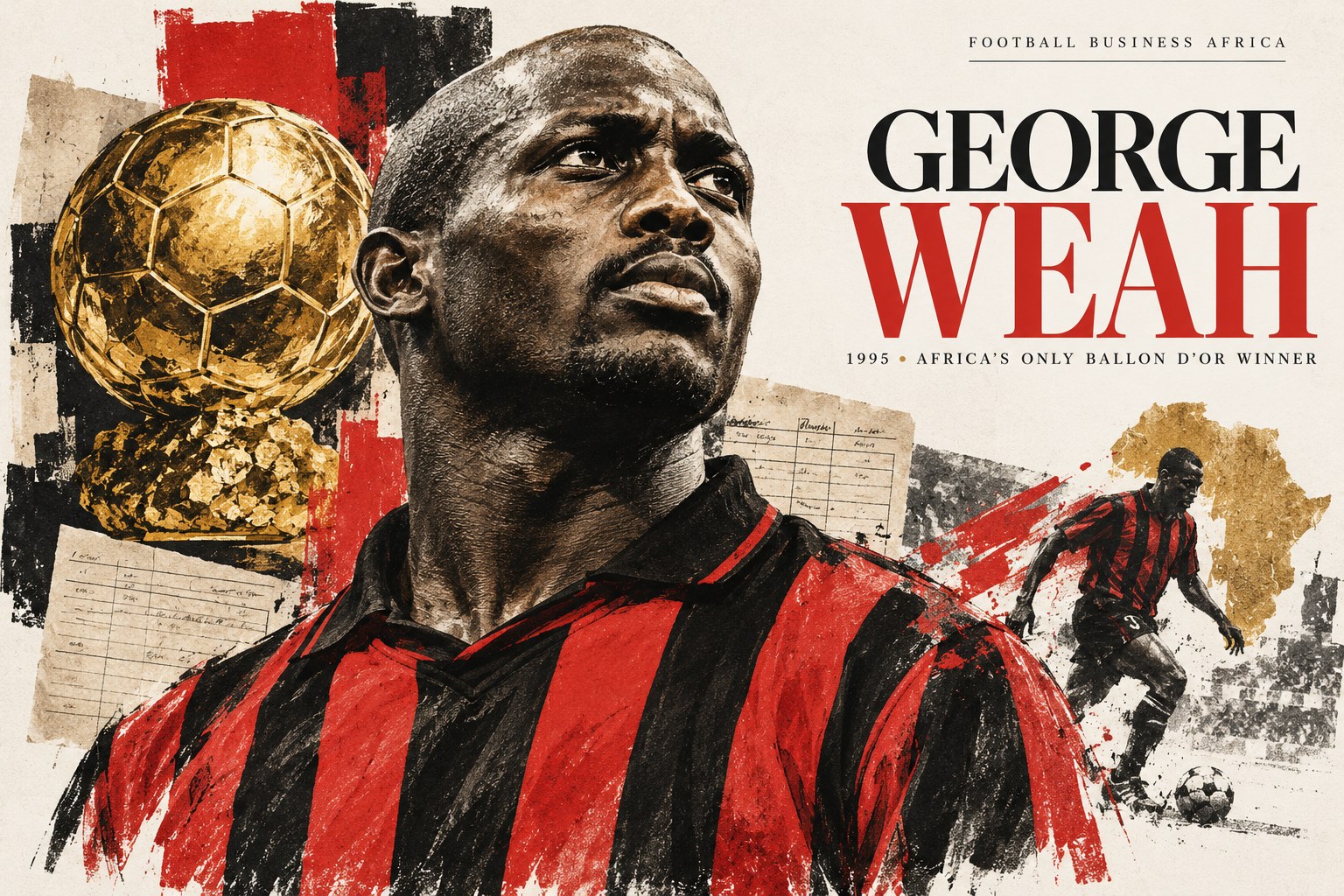
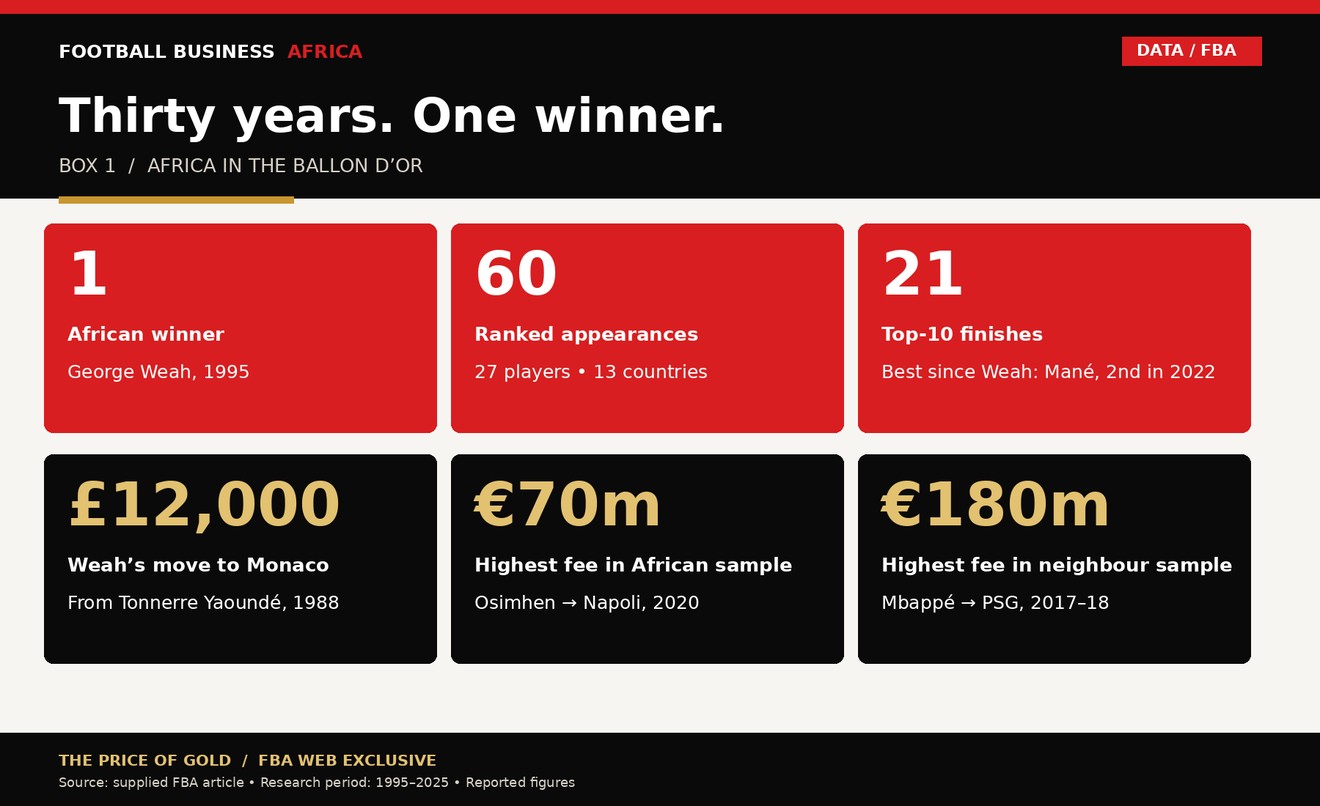
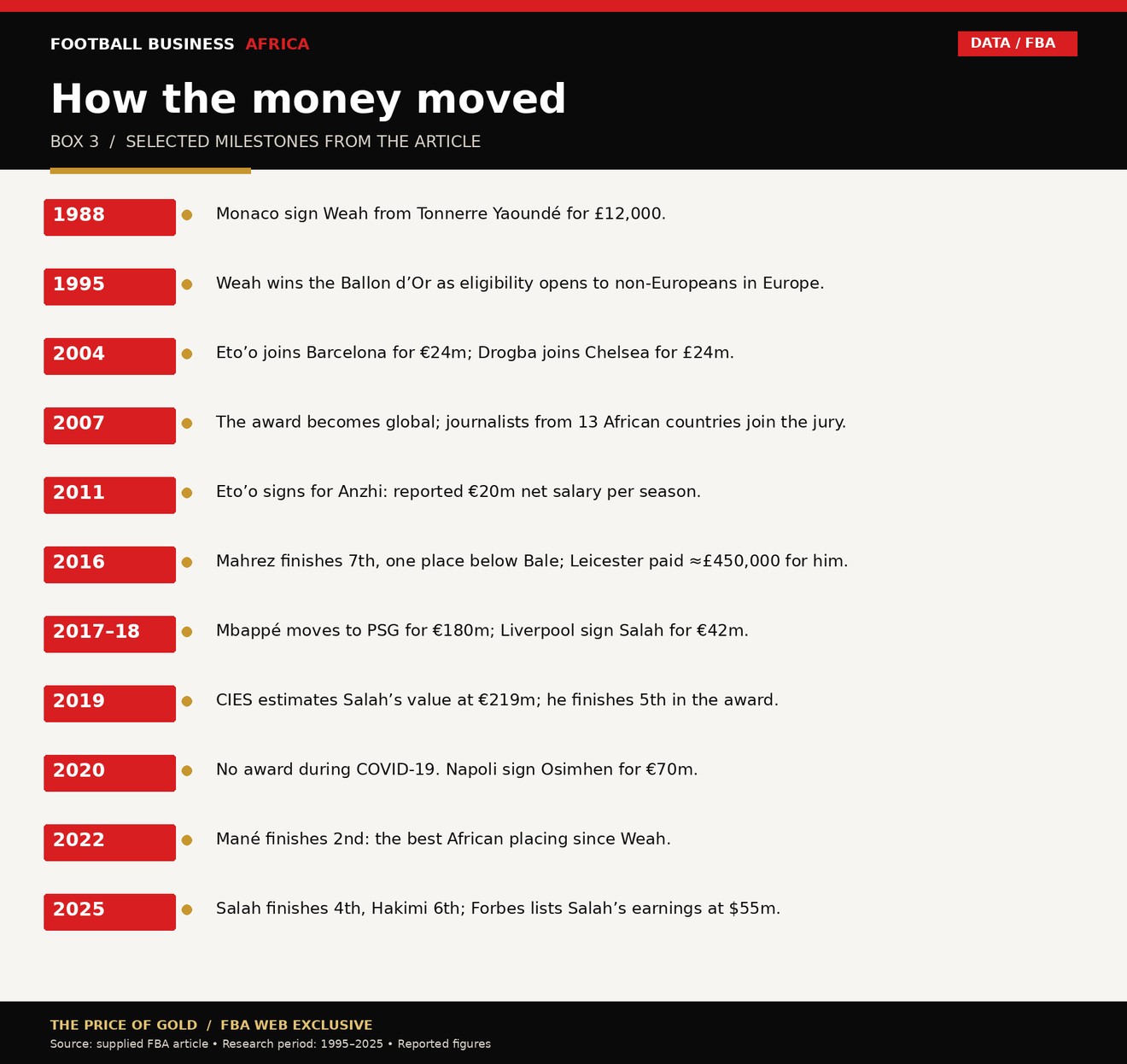
In 1988, AS Monaco paid Tonnerre Yaoundé £12,000, about $21,000, for a 21-year-old Liberian striker. Seven years later, in December 1995, that striker, George Weah, became the first player from outside Europe to win the Ballon d'Or.
It was the first year France Football allowed non-Europeans playing in Europe to compete. AC Milan had bought him from Paris Saint-Germain that summer for the equivalent of €6.9 million (about $9 million), a fraction of what the era's most expensive players cost.
Weah's story could have been the beginning of a series. It became an exception. Three decades and 30 editions later, he remains the only African to have won football's most famous individual prize. Yet African players have never been far from it. Between 1995 and 2025, 27 of them, from 13 countries, appeared 60 times in the official rankings, with 21 finishes in the top ten. Sadio Mané came second in 2022. Didier Drogba, Mané again and Mohamed Salah all finished fourth.
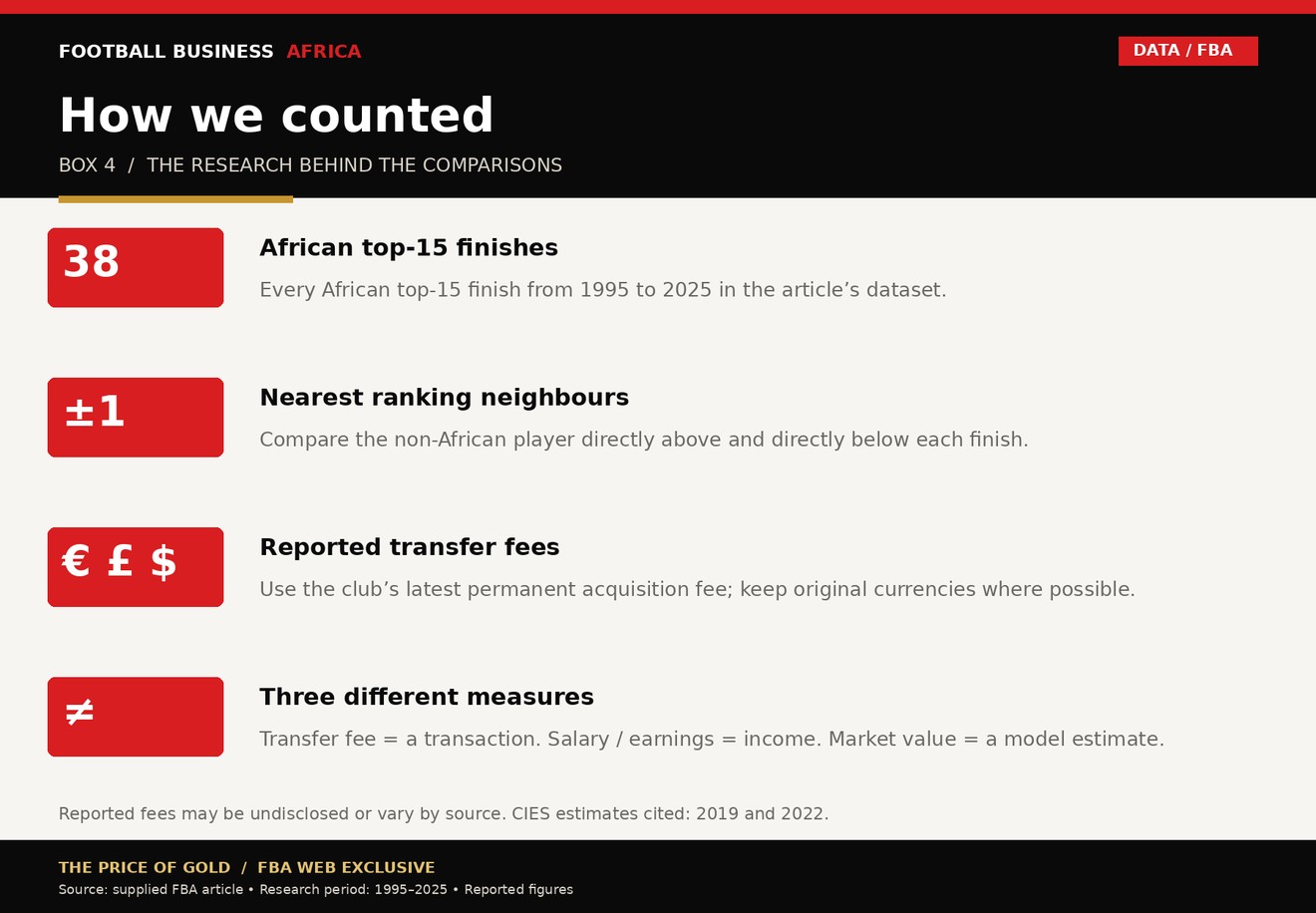
So the question here is not who should have won. It is a simpler one, and perhaps a more revealing one: what were these players worth, compared with the men ranked just above and just below them? To answer it, FBA looked at every African top-15 finish since 1995 and set it against the transfer fees, salaries and market values of their nearest non-African neighbours in the same ranking.
Equal in the Middle
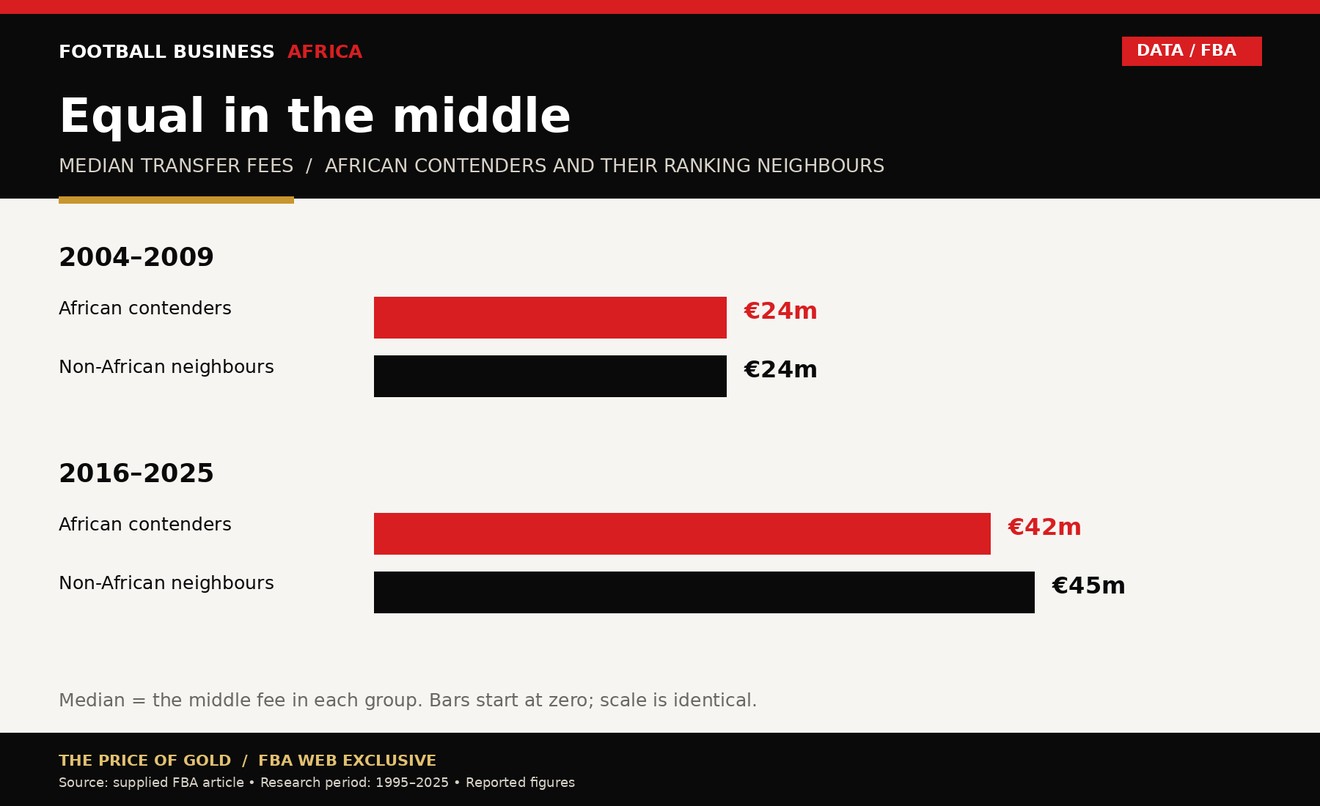
The first finding is a surprise. For most of this period, the typical African contender cost about as much as the players next to him in the vote.
Take the median, the fee of the player in the middle of the list. Between 2004 and 2009, the median African contender had cost his club €24 million, roughly $30 million. So had the median neighbour. Between 2016 and 2025, the figures were €42 million against €45 million, about $47 million against $50 million. On this measure, the gap between Africans and the rest of the leading group is close to nothing.
The money looks the same until you reach the very top of the market. There, the two lists part company.
The Record That Never Came
Among the non-Africans ranked next to Africans, the names read like a history of the world transfer record. Zinedine Zidane, who moved from Juventus to Real Madrid in 2001 for €77.5 million (about $69 million). Kaká, sold by Milan to Madrid in 2009 for €67 million (about $94 million). Gareth Bale, who cost Real €100 million (about $133 million) in 2013. Cristiano Ronaldo, bought by Juventus for €100 million (about $117 million) in 2018. Kylian Mbappé, who moved from Monaco to Paris Saint-Germain for €180 million, about $215 million.
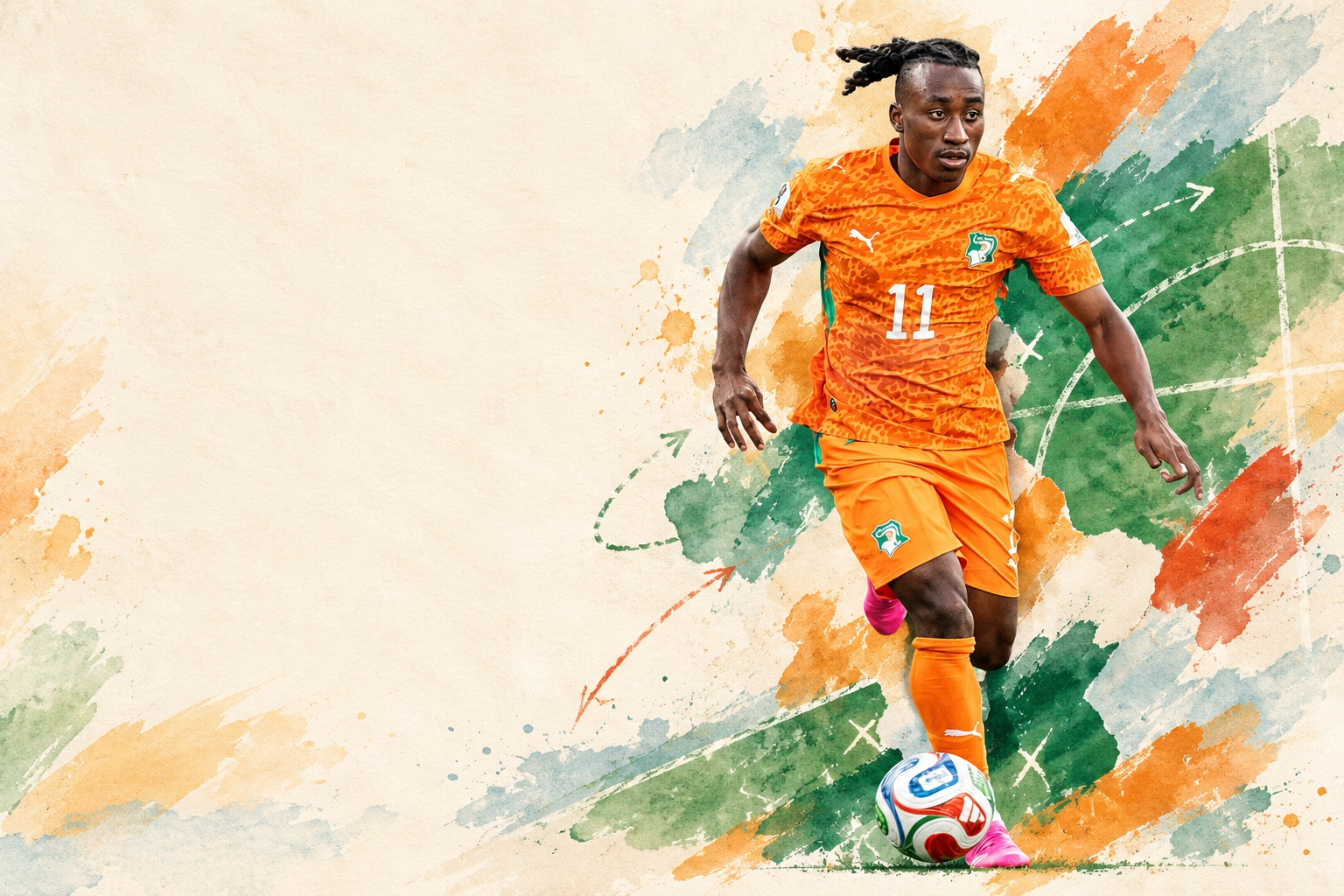
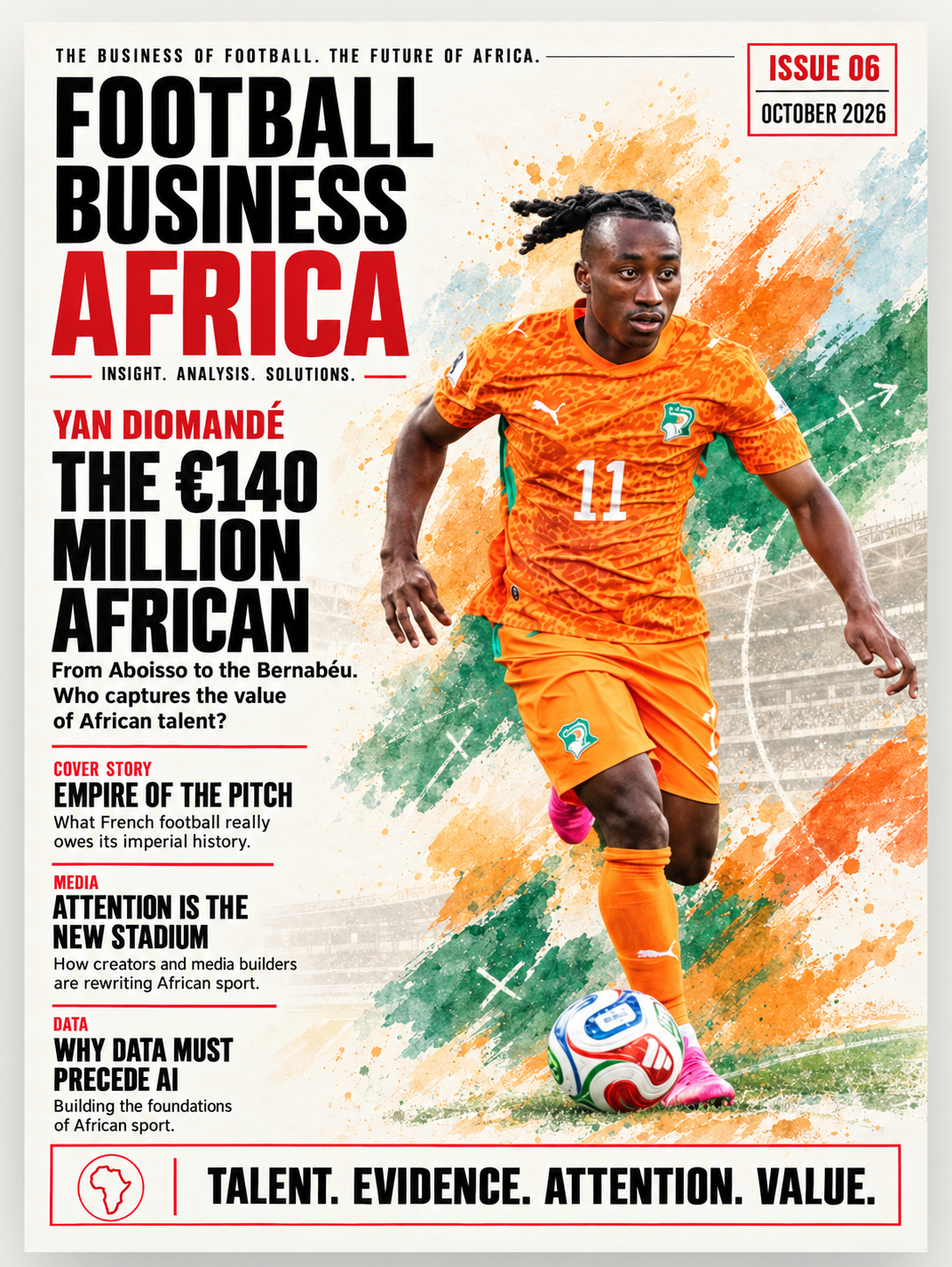
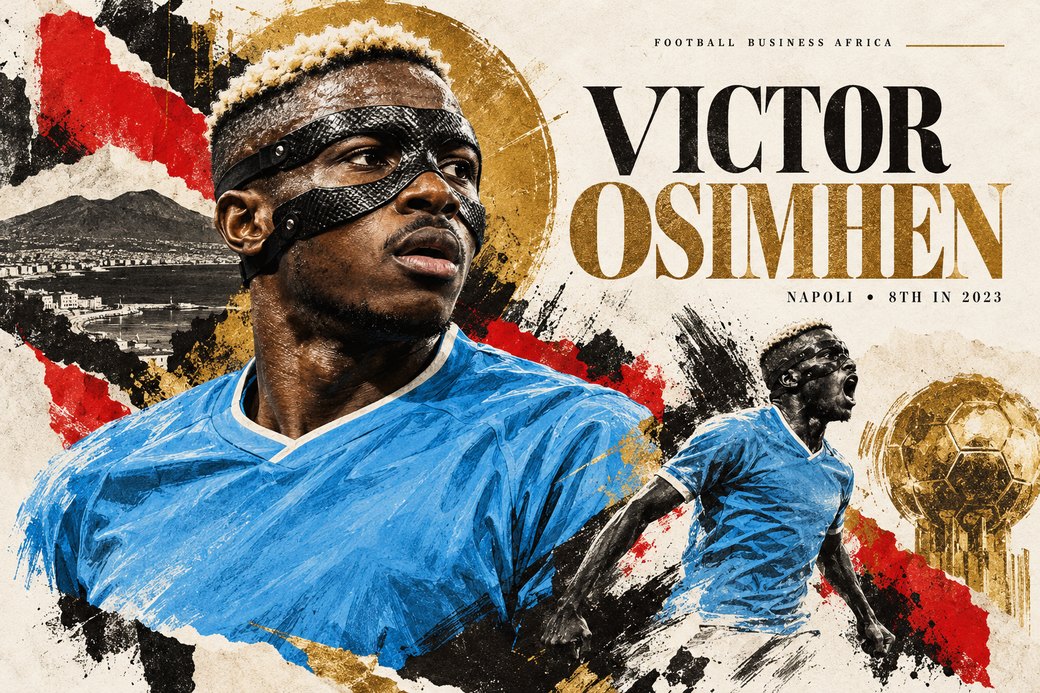
On the African side, the highest fee in these rankings is Victor Osimhen's: €70 million (about $82 million), paid by Napoli to Lille in 2020. Outside the rankings, Africa's transfer ceiling has since climbed far higher — Nicolas Pépé cost Arsenal €80 million in 2019, Bryan Mbeumo moved to Manchester United for €81 million in 2025, and in 2026 Real Madrid agreed a package worth up to €140 million for the 19-year-old Ivorian Yan Diomandé, the most ever paid for an African player. None of them, tellingly, has ever received a Ballon d'Or vote. No African ranked in the Ballon d'Or has ever been bought for €100 million or more.
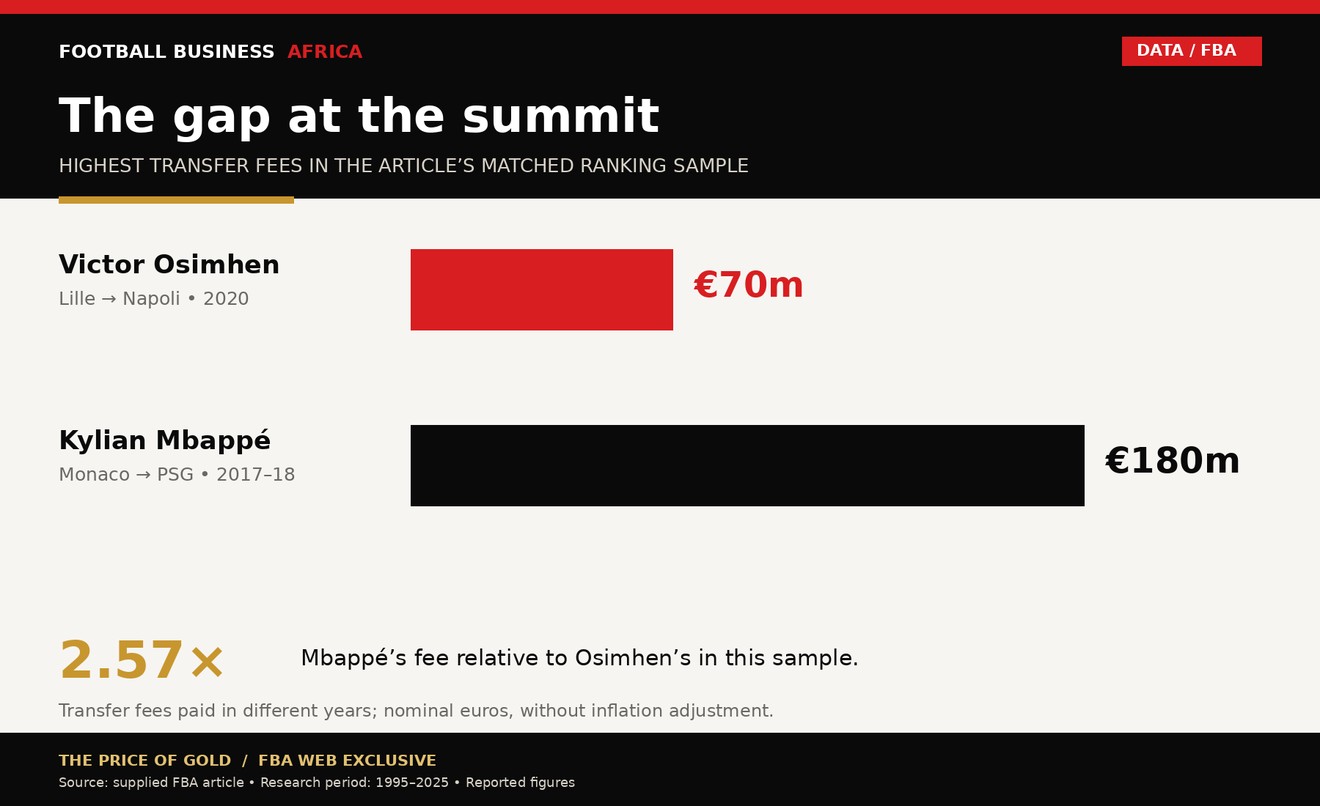
No African in the Ballon d'Or ranking has ever been bought for €100 million. The gap is not in the middle of the market. It is at the summit.
As fees have exploded, the distance at the top has grown. In the 2000s, the most expensive neighbour (Zidane) cost about twice as much as the most expensive African contender (Drogba, £24 million, about $44 million, in 2004). In the 2020s, Mbappé cost more than two and a half times as much as Osimhen.
Bought Cheap, Sold Dear
The second pattern explains part of the first. Africa's best players rarely arrived at the top of European football as finished products with a price to match. They arrived through side doors and became expensive only once they had proved themselves.
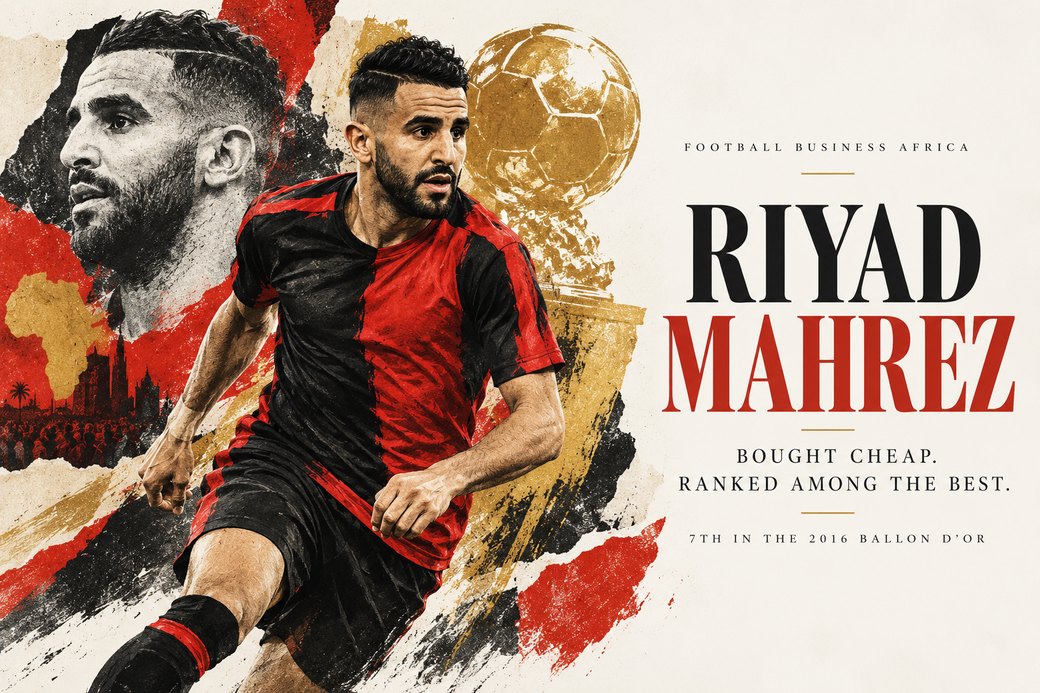
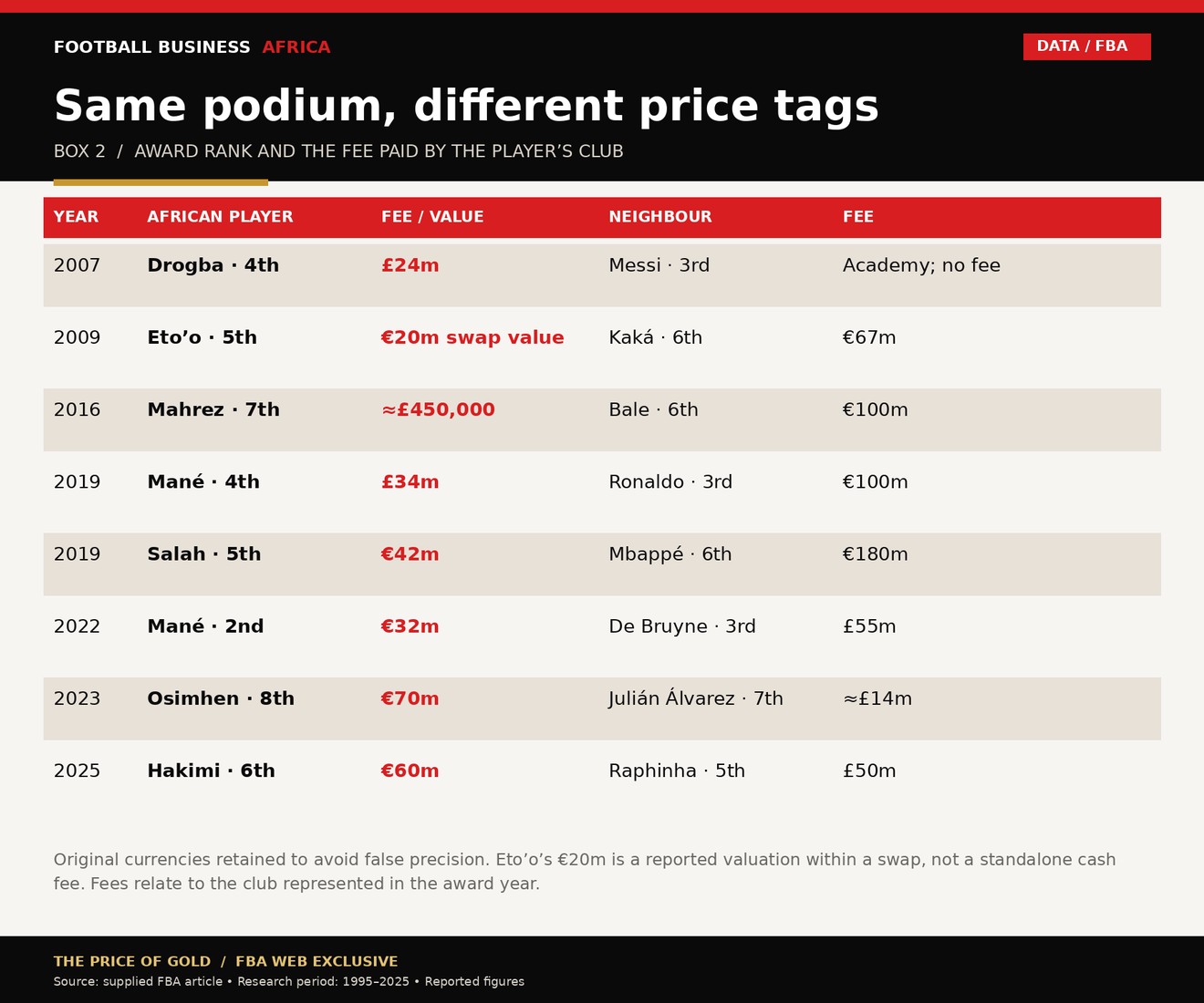
The 2016 Ballon d'Or offers the starkest illustration. In seventh place was Riyad Mahrez, who had helped Leicester City win the Premier League. Leicester had bought him from Le Havre, in France's second division, for about £450,000, roughly $750,000. One place above him was Gareth Bale, the €100 million man. Two of the best players of that year were separated by one place in the vote and by a factor of more than 150 in their price.
The same route appears again and again. Mané went from Metz to Red Bull Salzburg for €4 million in 2012, then to Southampton for £11.8 million, then to Liverpool for £34 million (about $45 million) in 2016. Osimhen went from Charleroi in Belgium to Lille for €12 million (about $13.5 million) in 2019; a year later Lille sold him for nearly six times that sum. Samuel Eto'o, discarded by Real Madrid, was rebuilt at Mallorca, which had paid £4.4 million for him, before Barcelona bought him for €24 million (about $29 million) in 2004.
Much of the value created by Africa's stars was captured by the clubs in between — in Lille, Salzburg or Leicester. African clubs appear only at the start of these chains, for small sums.
For the clubs that buy early, the model works very well. For the players, it means their best-paid years come later. For African football, it means that the value of its finest exports is captured elsewhere — a pattern we traced across a whole transfer window in The Goldmine Paradox, and counted club by club in the Top 50.
A Pay Gap That Closed Late
Salaries tell a similar story, though they are harder to document because clubs rarely publish them. A survey of the 2009–10 season, compiled by Futebol Finance, gives a useful snapshot. Drogba, ninth in the 2009 Ballon d'Or, earned about €5.5 million a year (about $7.6 million). Wayne Rooney, eighth, earned €6 million. Steven Gerrard, tenth, earned €7.5 million. Eto'o, fifth, was paid as well as Messi, at €10.5 million, but he was an exception.
The biggest African contracts of that era came from outside Europe's elite. In 2011 Eto'o joined Anzhi Makhachkala in Russia for a reported salary of €20 million net a season, about $29 million, which made him the best-paid footballer in the world. A year later Drogba left Chelsea for Shanghai Shenhua, reportedly on about £200,000 a week, roughly $314,000. At Manchester City, Yaya Touré was the main exception inside the European elite, with a reported basic wage of £185,000 a week (about $280,000) when he arrived in 2010.
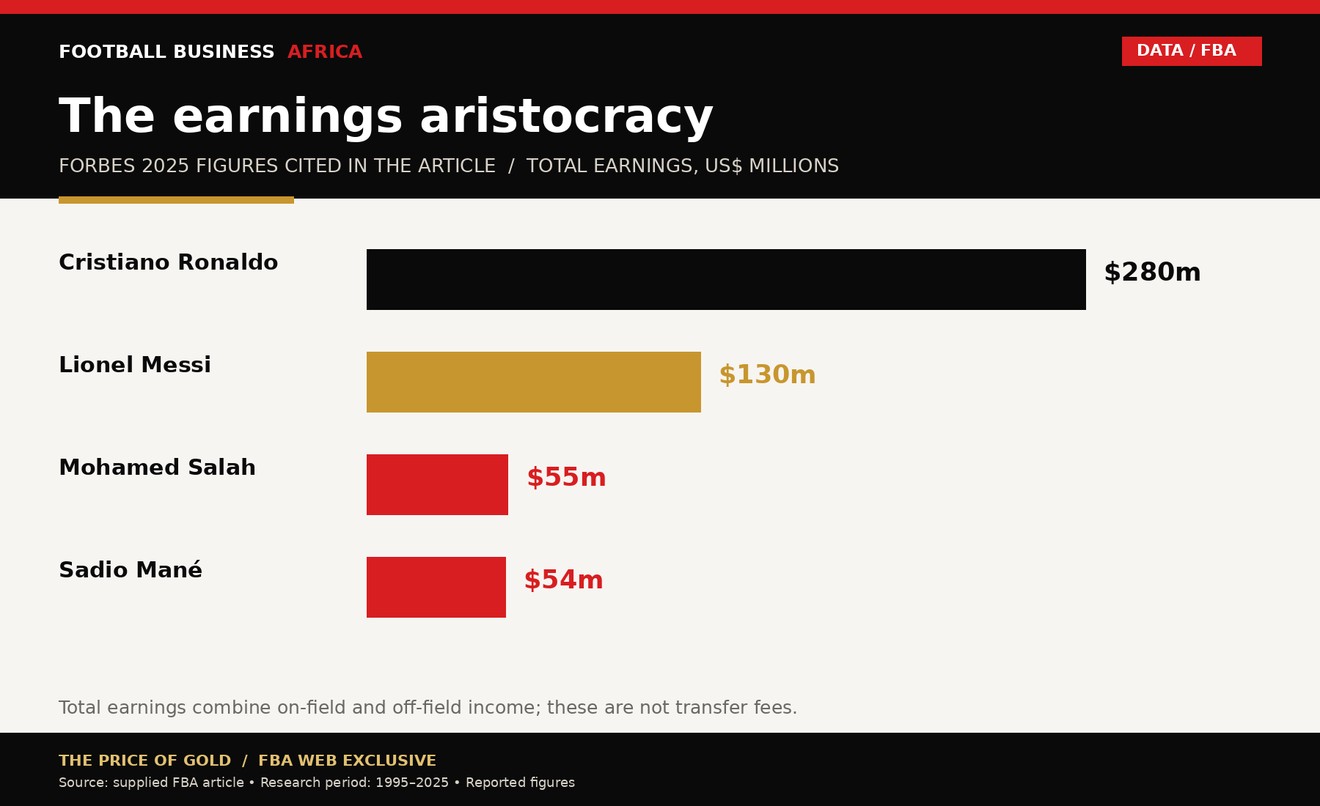
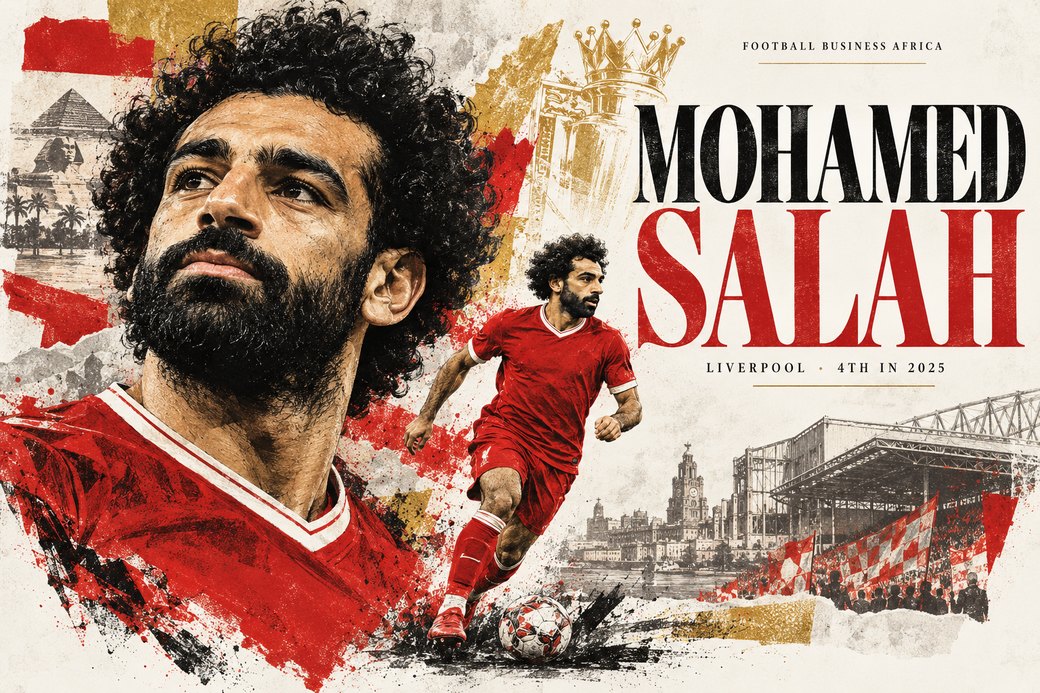
The gap has since narrowed. In 2022 Salah signed a new Liverpool contract reported at up to £350,000 a week, about $424,000. Forbes placed him fifth among the world's highest-paid footballers in 2022 and seventh in 2023 and 2025, with total earnings of $55 million in its 2025 list. At Paris Saint-Germain, Achraf Hakimi earns about €1.1 million a month before tax, roughly $1.2 million, according to L'Équipe. That is more than Vitinha, who finished three places above him in the 2025 Ballon d'Or.
What remains is the distance to a small aristocracy. In Forbes' 2025 list, Salah's $55 million compares with $280 million for Cristiano Ronaldo and $130 million for Lionel Messi. Sadio Mané, at Saudi club Al Nassr, earned $54 million, almost exactly Salah's total. Once again, the largest African paycheque was signed far from the clubs that dominate the Ballon d'Or.
When the Market Disagreed With the Jury
Sometimes the market rated Africans higher than the voters did. In June 2019, the CIES Football Observatory in Switzerland, which estimates transfer values with a statistical model, valued Salah at €219 million (about $247 million). That made him the second most valuable player in Europe's five big leagues, behind Mbappé and ahead of both Messi (€167 million) and Ronaldo (€118 million). In that year's Ballon d'Or, Salah finished fifth, behind both of them.
The model also shows how quickly value fades with age. By June 2022, at 30, Salah was estimated at €55 million (about $58 million), although he finished fifth in the Ballon d'Or again that year. Hakimi, then 23, was Africa's most valuable player at €75.2 million.
Why the Ceiling Holds
The figures do not prove why African players have been priced this way, and they should not be made to say more than they do. But several explanations fit them.
Most of these players crossed into Europe young and cheap, through French, Belgian or Austrian clubs that specialise in buying low and selling high. By the time the giants of Madrid, Barcelona or Paris could have paid a record fee, the players were often already at clubs that would not sell, or in their late twenties, when fees fall. And the most lucrative markets open to African stars late in their careers, in Russia, China and now Saudi Arabia, pay salaries rather than transfer fees.
The vote itself has changed. Since 2007, journalists from African countries have taken part in the Ballon d'Or jury. Africans have since finished second and fourth. The price tag, however, has not followed.
The Bottom Line
In thirty years of Ballon d'Or rankings, Africa's best players have been as good as the men around them and, for most of the period, about as expensive.
The difference is not talent, and not the average price. It is the summit of the market, where no African has ever been bought at a record fee, and the timing of the money, which reaches African stars late and often far from Europe's richest clubs. Weah's £12,000 transfer in 1988 now looks like a parable. The talent was African. Most of the profit was made elsewhere.
That is the deeper significance of a deal like Yan Diomandé's. A nine-figure fee for a teenager developed in Côte d'Ivoire rewrites the ceiling — but, as we argued in The €140 Million African, the real breakthrough comes not when another African costs more, but when African academies and clubs keep a greater share of the value they create. On 26 October 2026, when the Ballon d'Or is handed out in London with Hakimi and Mané among the nominees, that gap between talent and price will be in the room, even if no one reads it out.
Sources & further reading
- 01
Rankings — RSSSF & France Football
European Footballer of the Year (Ballon d'Or) full voting tables 1995–2009; yearly Ballon d'Or and FIFA Ballon d'Or results citing France Football, L'Équipe and FIFA (2016, 2022); Soccerway for 2025 points.
- 02
Transfer fees — press and club records
List of most expensive association football transfers; 1995–96 AC Milan season (Weah); FourFourTwo (Drogba); Gianluca Di Marzio (Salah); Sky Sports (Mané); club and press reports for Weah, Eto'o, Mahrez, Mané, Osimhen, Hakimi, Kaká, Bale, De Bruyne, Álvarez and Raphinha; Football365 (Álvarez).
- 03
Salaries and earnings
Foot Mercato, citing Futebol Finance, 2009–10 salaries; The Moscow Times (Eto'o at Anzhi); Gulf Times (Drogba in Shanghai); Goal (Yaya Touré); CGTN (Salah's 2022 contract); Sports Illustrated and Forbes 2025 list; Soccerway, citing L'Équipe's Ligue 1 salaries.
- 04
Market values — CIES Football Observatory
CIES Football Observatory, June 2019; Morocco World News, citing CIES, June 2022. See football-observatory.com for monthly reports on player values and migration.
- 05
Further reading
Transfermarkt (historical fees and market values); Forbes (annual highest-paid list); Deloitte Football Money League; RSSSF ballot-by-ballot results from 1956; Simon Kuper & Stefan Szymanski, Soccernomics; Paul Darby, Africa, Football and FIFA; Laurent Dubois, Soccer Empire.
- 06
The full FBA data
FBA research documents "African Players in the Ballon d'Or Rankings, 1995–2025" and "African Ballon d'Or Contenders: Transfer Fees, Salaries and Market Values, 1995–2025". Dollar figures are approximate, at the exchange rate of the time.