
In August in 2025, Bryan Mbeumo completed his €81 million transfer from Brentford to Manchester United. The Cameroonian forward's move shattered records, making headlines across Europe and the world. But Mbeumo’s transfer fee—enough to fund Cameroon's entire professional league for decades—would never touch African soil. Not a single euro of that astronomical sum went to an African club. Mbeumo, like other African football players nowadays, born in France to Cameroonian parents, is a product of the French football system.
This is the story of modern African football: a continent that produces some of the world's most valuable players but captures virtually none of the wealth they generate. It's a system so efficient at extraction that it would make colonial-era commodity traders envious.
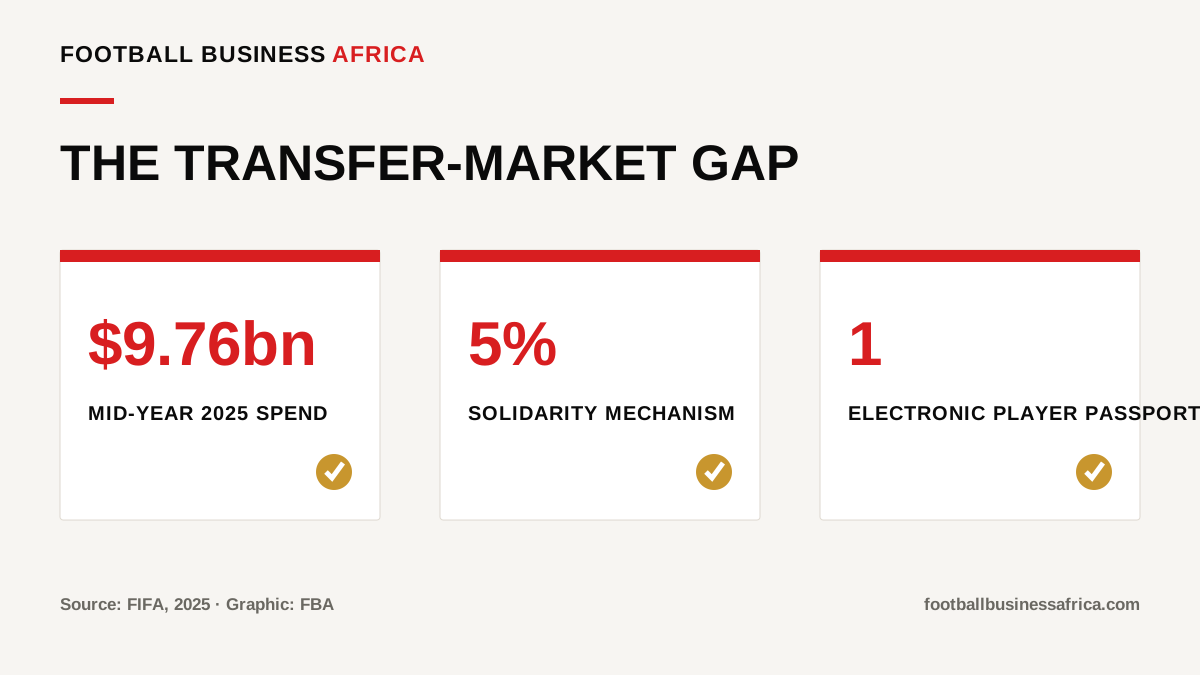
The African football transfer market from 2020 to 2025 tells a tale of two economies existing in parallel universes. In one, global transfer spending has exploded to unprecedented heights, surpassing $9.7 billion in the 2025 mid-year window alone. In the other, African clubs operate on budgets that wouldn't cover a European star's weekly wages, selling their best talents for a fraction of their eventual worth and watching helplessly as these same players are later traded between European clubs for tens of millions.
This isn't just an economic imbalance—it's a systematic value drain that threatens the very foundation of African football. Yet within this crisis lie the seeds of transformation, as innovative academies, emerging digital markets, and a new generation of African football executives begin to challenge a system that has treated the continent as little more than a talent quarry for the world's richest leagues.
The data is stark enough to make even seasoned football economists wince. In 2022, according to a FIFA report, the total receipts earned by African clubs from international player transfers stood at $71.2 million, some $10 million less than Mbeumo’s transfer to Manchester United.
"Africa is characterized by the loss of football added value," says an economist in Abidjan who has looked at the numbers, with the weariness of someone who's watched this movie too many times. "Africa benefits poorly or little from the added value created at the football level."
The numbers bear him out. Nigeria, now ranked fifth globally in international transfers conducted, has seen its player exports surge by 57% since 2020. The country now has 500 players scattered across 135 leagues worldwide. Yet the Nigerian Professional Football League's total market value stands at a pitiful €1.05 million—less than what a single Nigerian international like Victor Osimhen earned in a month at Napoli before moving to Turkey.
The Extraction Machine
The mechanism of this value extraction has been perfected over decades into an almost frictionless system. European clubs have built sophisticated scouting networks that penetrate deep into African youth football, identifying talents as young as 12 or 13. These players are offered opportunities that no African club can match: proper nutrition, world-class coaching, medical care, and the promise of European wages.
The most insidious part of this system is how it bypasses African professional football entirely. Generation Foot in Senegal, perhaps Africa's most famous academy, has a direct pipeline to FC Metz in France. The best graduates—players like Sadio Mané and Ismaïla Sarr—never play a professional match in Senegal. They go straight from the academy to Europe, denying local leagues the star power that could attract sponsors, broadcasters, and fans.
Right to Dream in Ghana has taken this model even further. The academy doesn't just partner with European clubs; it owns one. By acquiring FC Nordsjælland in Denmark, Right to Dream created a closed-loop system that captures the full value chain of player development. It's a brilliant business model—unless you're Ghanaian football, watching your best talents disappear into a system that enriches everyone except you.
The scenario plays out from Nigeria to Cameroon, from Kenya to the Democratic Republic of Congo.
Technology was supposed to level the playing field. Streaming platforms and social media promised to help African leagues build global audiences and monetize their massive local fanbases. Tanzania's league, energized by a
$100 million broadcast deal over 10 years with Azam TV, showed what was possible.
But technology has proven to be a double-edged sword. The same digital tools that could build African football's economic independence have instead perfected the extraction machine.
Africa produces the world’s most valuable players but captures virtually none of the wealth they generate.
European clubs now use sophisticated data analytics to identify African talents earlier and more efficiently than ever. Young players in remote academies are now just a YouTube highlight reel away from European attention.
The result is perverse: increased visibility has accelerated the talent drain rather than stemming it. African leagues find themselves competing not just with European television broadcasts but with a globalized scouting system that can pluck their best players before local fans even know their names.
The Promise of Compensation
FIFA's training compensation and solidarity payment mechanisms were designed to ensure that clubs who develop young players receive financial rewards when those players succeed. In theory, African clubs should receive 5-10% of every international transfer fee involving players they trained.
In practice, it's not that simple, many actors in Africa’s football ecosystem note. An estimated 80% of training compensation owed to African clubs is never paid, said one who has requested anonymity out of fear of compromising relationships.
The reasons are depressingly predictable: African clubs lack the legal resources to pursue claims, regulatory loopholes favor wealthy European clubs, and the power imbalance makes challenging non-payment almost impossible.
Consider this: When Victor Osimhen moved from Napoli to Galatasaray for €75 million in 2025, his youth clubs in Nigeria should have received millions in solidarity payments. Most will be lucky to see anything at all.
Within Africa itself, a parallel extraction system has emerged. The continent's football economy is increasingly polarized between a handful of wealthy leagues—Egypt, Morocco, South Africa, Algeria, Tanzania, and Tunisia—and everyone else. The Egyptian Premier League's market value of €154 million dwarfs that of most other African leagues combined.
These financial powerhouses operate as regional hubs, drawing talent from neighboring countries in a miniature version of the Europe-Africa dynamic.
During the 2025 transfer window, Moroccan clubs registered 151 incoming international transfers. Most came from other African nations that couldn't match Moroccan wages or facilities.
The launch of the African Football League (AFL) two years ago, an invitation-only tournament for the continent's elite clubs, further threatens to accelerate this polarization. With its promise of $100 million in revenue, the AFL could further concentrate wealth among Africa's football aristocracy while leaving smaller leagues even further behind.
Perhaps the most troubling trend is what researchers call the "hollowing out" of African football. While African player exports have surged, the number of foreign players in African leagues has declined by 14.4% since 2020. This means African leagues are losing their best players without attracting equivalent replacements.
The mathematics are brutal. Leagues lose their stars, quality drops, fans lose interest, sponsors withdraw, revenues decline, and clubs become even less able to retain the next generation of talent. It's a vicious cycle that threatens to reduce many African leagues to irrelevance.
We need a "circular economy" where wealth generated by player exports systematically returns to develop the next generation.
The talent will keep flowing. Whether the wealth flows back is a choice Africa must make — and soon.
Seeds of Revolution
Yet within this crisis, innovation is stirring. Some African football executives are beginning to challenge the established order with creative solutions.
Multi-club ownership models pioneered by Right to Dream offer a template for value retention. African investors are exploring regional club networks that could keep talent within African-owned structures longer, developing players to higher levels before selling them at premium prices.
The push for mandatory sell-on clauses—requiring 15-25% of future transfer fees to return to the original African club—is gaining momentum. If widely adopted, these clauses could ensure African clubs share in the massive appreciation of their players' values.
Some federations are reported to be establishing legal task forces to pursue unpaid training compensation aggressively. Funded by levies on outgoing transfers, these units could reclaim millions in owed payments that currently disappear into European coffers.
The ultimate vision, articulated by progressive voices in African football, is a "circular economy" where wealth generated by player exports systematically returns to develop the next generation. It's an ambitious dream that would transform Africa from football's quarry to its jeweler—a continent that not only produces rough diamonds but polishes them, sets them, and profits from their full value.
Achieving this vision requires fundamental changes: stronger leagues that can retain talent longer, professional academies that capture more value from player development, effective legal mechanisms to ensure compensation, and digital strategies that build global audiences for African football rather than just showcasing its talents for European consumption.
The Clock Is Ticking
The stakes couldn't be higher. Africa has the world's youngest population, with 70% of its
1.4 billion people under 30. This demographic dividend could power a football revolution—or watch its dreams dribble away to enrich foreign leagues.
The 2020-2025 period has shown that without intervention, Africa's role as football's primary supplier will only intensify. European clubs are getting better at extraction, their scouting networks deeper, their financial advantages greater. The transfer market's explosive growth—from pandemic contraction to record-breaking billions—has benefited everyone except those who produce the game's essential commodity: the players themselves.
As Bryan Mbeumo settles into Manchester, his
€81 million transfer fee circulating through European bank accounts, the question isn't whether Africa can change this system. It's whether it will act before the beautiful game's ugliest economic reality becomes permanent. The talent will keep flowing—that much is certain. Whether any of the wealth flows back is a choice that Africa must make, and soon.
The continent that gives world football its rhythm, flair, and increasingly its stars, deserves more than pennies on the euro. It deserves a stake in the game it helps make beautiful. The next five years will determine whether Africa remains football's exploited gold mine or becomes its empowered partner. The clock, as they say in football, is ticking.
Sources & further reading
Public documents and reporting used to verify the article. Links open the original source.
- 01
FIFA: record international transfers in 2025
- 02
FIFA 2025 mid-year transfer report
- 03
FIFA Clearing House regulations
- 04
Manchester United: Bryan Mbeumo
Originally published in Football Business Africa, Issue 03 · Oct–Dec 2025.