On the evening of Sunday 16 August, at the Moulay El Hassan Stadium in Rabat, Cameroon's women finally won the trophy that had slipped away from them three times. The prize that came with it was the largest ever paid in African women's football. The money that reaches their clubs, and most of their peers, is another story.
Cameroon had lost the final of the Women's Africa Cup of Nations (WAFCON) to Nigeria in 2004, in 2014 and again in 2016, without scoring in any of them. This time the match was over by half-time. Marie-Gisèle Ngah Manga headed the first goal after 20 minutes, Naomi Eto added a second, and Ngah Manga scored again in stoppage time before the break. Malawi, the tournament's newcomers and its great surprise, never recovered. The score was 3–0.
It was an improbable title. Cameroon had not qualified on the pitch: they were let in only when the Confederation of African Football (CAF) expanded the tournament from twelve teams to sixteen. Their coach, Valentine Nguele, had been appointed only weeks before. Their captain, Gabrielle Onguene, came on as a substitute at 37 and had a late goal ruled out for offside. FIFA's president, Gianni Infantino, watched from the stands.
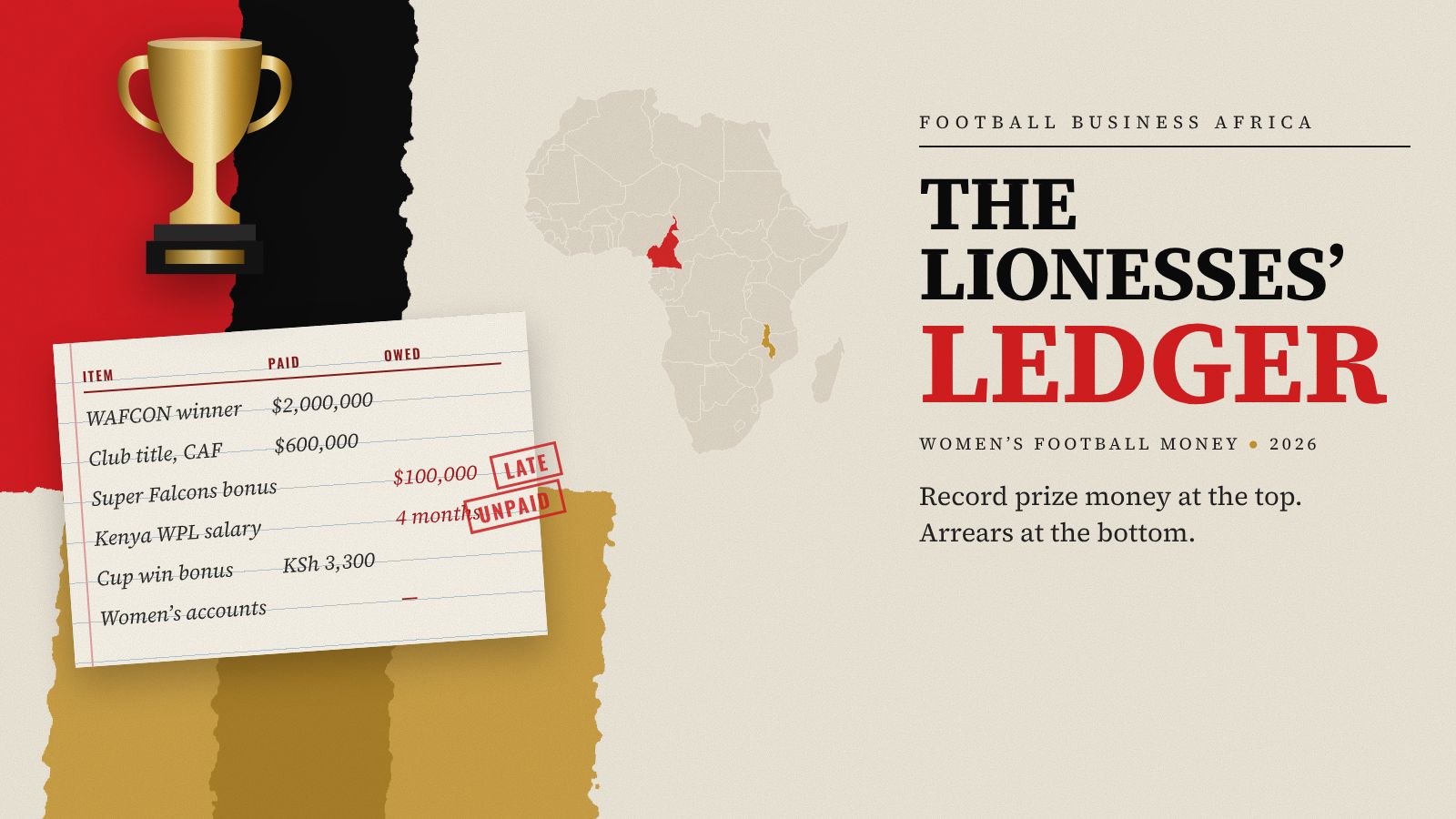
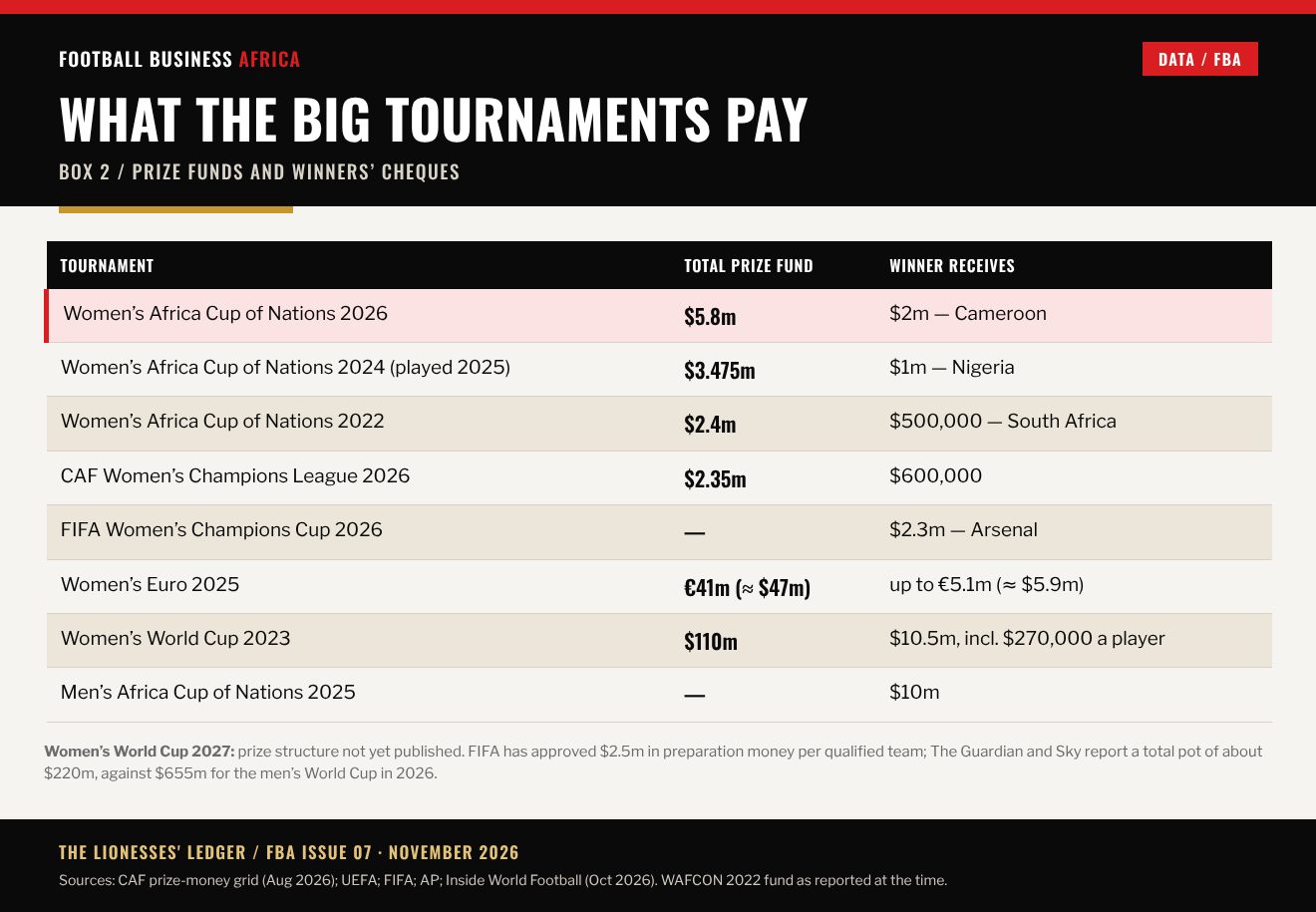
The victory came with a cheque for $2 million. Four years earlier, the same trophy had been worth a quarter of that. Before 2021, a tenth.
That number tells a story of progress, and it is true. But it is only half the story. The same summer, Nigeria's players, champions a year earlier, were still waiting for rewards their president had promised them; the money arrived only this month, sixteen months late. In Kenya, eleven clubs in the women's top division had gone on strike in March over salaries unpaid for months. African women's football has never had more money at the top. At the bottom, it often has almost none.
Two Economies
To understand the money in African women's football, it helps to picture two separate economies that rarely touch.
The first is an economy of events. Every year or two, a tournament arrives, with television cameras, a title sponsor, a prize fund and a presidential reception. Here the money is real and growing fast, and it comes mostly from above: from CAF, from FIFA, from governments eager to be photographed with winners.
The second is an economy of ordinary weeks. It is the Tuesday training session, the bus to an away match, the monthly salary, the physiotherapist. This is where a professional sport is actually built, and in most of Africa it is barely financed. Leagues have no broadcast contract and often no sponsor. Many players have no written contract at all.
The richest women's leagues in the world, in the United States and England, grew the other way round. Their weekly economy came first: television rights, shirt sponsors, ticket sales, and then salaries rising to match. African women's football is attempting the climb from the top rung down.
African women's football is attempting the climb from the top rung down: prize money first, salaries later — if at all.
Money From Above
The man behind the Rabat cheque is Patrice Motsepe, the South African mining billionaire who has led CAF since 2021. Under him, the women's Cup of Nations winner's prize has risen tenfold, from $200,000 to $2 million, and the total prize fund has grown to $5.8 million, up 67% on the previous edition alone. CAF's women's club competition, the Champions League created in 2021, now pays its winner $600,000; its 2026 edition is being played in Ismailia, Egypt, as this issue goes to press.
By Asian or South American standards, this is generous. The entire prize fund of the AFC Women's Asian Cup, reported at $1.8 million, is smaller than the cheque Cameroon received. Motsepe has said more than once that the increases should translate into better salaries for players, coaches and staff.
By European standards, it is modest. The women's European Championship of 2025 shared €41 million, about $47 million, or eight times Africa's pot. And the most telling comparison is closer to home. When the men's Africa Cup of Nations was played in Morocco eight months before the women's, its winner received $10 million: five times what Cameroon's women took home.
There is also a difference that does not show in the totals. At Women's Euro 2025, UEFA required federations to pass between 30% and 40% of their prize money directly to their players. At the 2023 World Cup, FIFA guaranteed every player at least $30,000. CAF has no such rule. When the prize reaches a federation, what happens next is up to the federation.
The Promise and the Payout
No country illustrates the distance between announcement and payment better than Nigeria, the continent's great power in women's football, with ten African titles.
In July 2025 the Super Falcons won their tenth in spectacular fashion, coming back from two goals down to beat the hosts, Morocco, 3–2 in Rabat. Back in Abuja, President Bola Tinubu received them at the State House and announced the most generous reward in the history of African women's football: the naira equivalent of $100,000 for each player, $50,000 for each member of staff, a three-bedroom flat each, and a national honour. In a country where the monthly minimum wage, ₦70,000, is worth about $45, it was a life-changing sum.
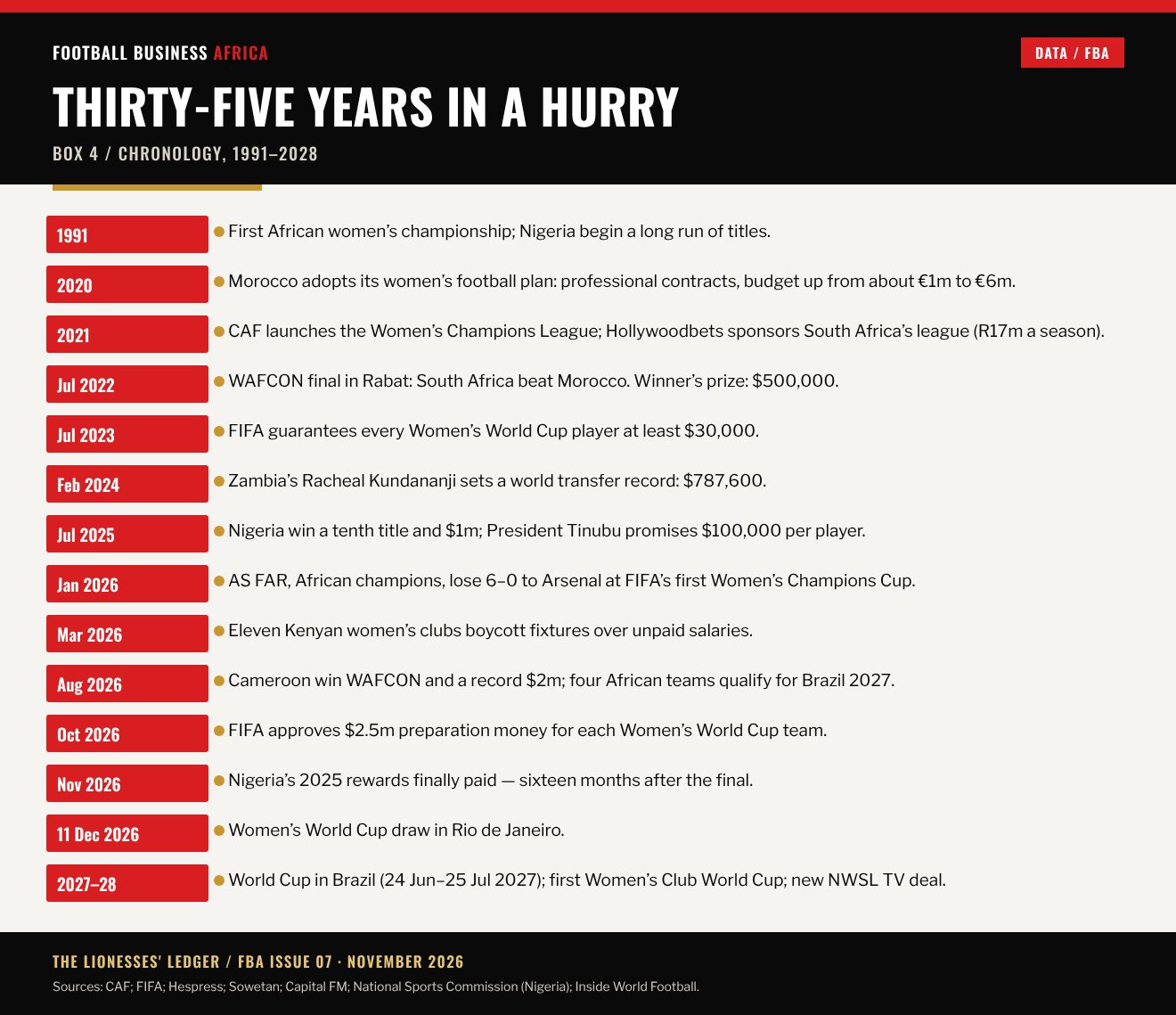
The honours were conferred quickly. The money was another matter. Months after the final, the captain, Rasheedat Ajibade, said on a popular Nigerian talk show that nothing had arrived. The National Sports Commission replied that the president had approved the payments in August 2025. The players went into the 2026 tournament with the rewards still unpaid. This time they were knocked out in the quarter-finals, by Cameroon, and then lost a World Cup play-off to South Africa. Only on 2 November 2026, sixteen months after the final, did the commission announce that players and officials had been paid.
In a system where national-team money is the most visible income a player can hope for, that income depends on budgets, ministers and moods rather than contracts.
It is an old pattern. In 2016, after an earlier title, the Falcons staged a sit-in at their Abuja hotel until the federation paid what it owed them. In 2022 they boycotted training at the Cup of Nations over unpaid allowances. The point is not that Nigeria is uniquely careless. It is that the money arrives as a favour, not as a wage.
The Export Economy
If Africa's women's leagues are poor, its best players are not. They have simply learned to earn their living elsewhere.
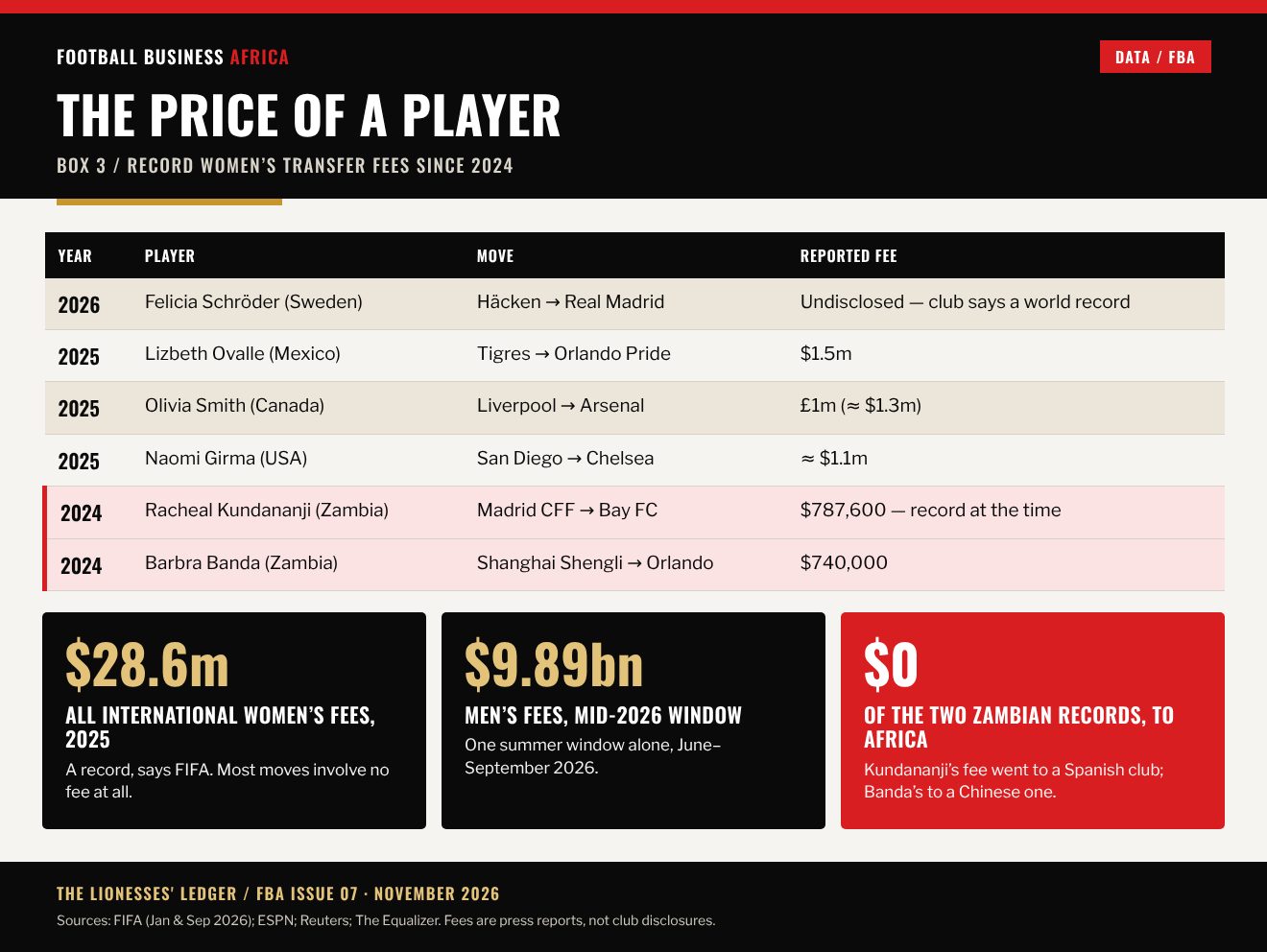
Racheal Kundananji grew up in Zambia playing football in secret; she has said her family thought she was at a friend's house. In February 2024, Bay FC, a new club in San Francisco, paid Madrid CFF $787,600, plus up to $75,000 in bonuses, to sign her. It was the highest fee ever paid for a woman footballer at the time. A month later her compatriot Barbra Banda moved from Shanghai Shengli to the Orlando Pride for $740,000, then the second-highest fee in history.
Their records did not last. The ceiling has since passed the million-dollar line — Naomi Girma to Chelsea, Lizbeth Ovalle to Orlando at $1.5 million, and in June 2026 Felicia Schröder to Real Madrid for an undisclosed fee that her Swedish club, Häcken, called the highest ever. But the Zambians showed something important: African players were now being priced on a global scale.
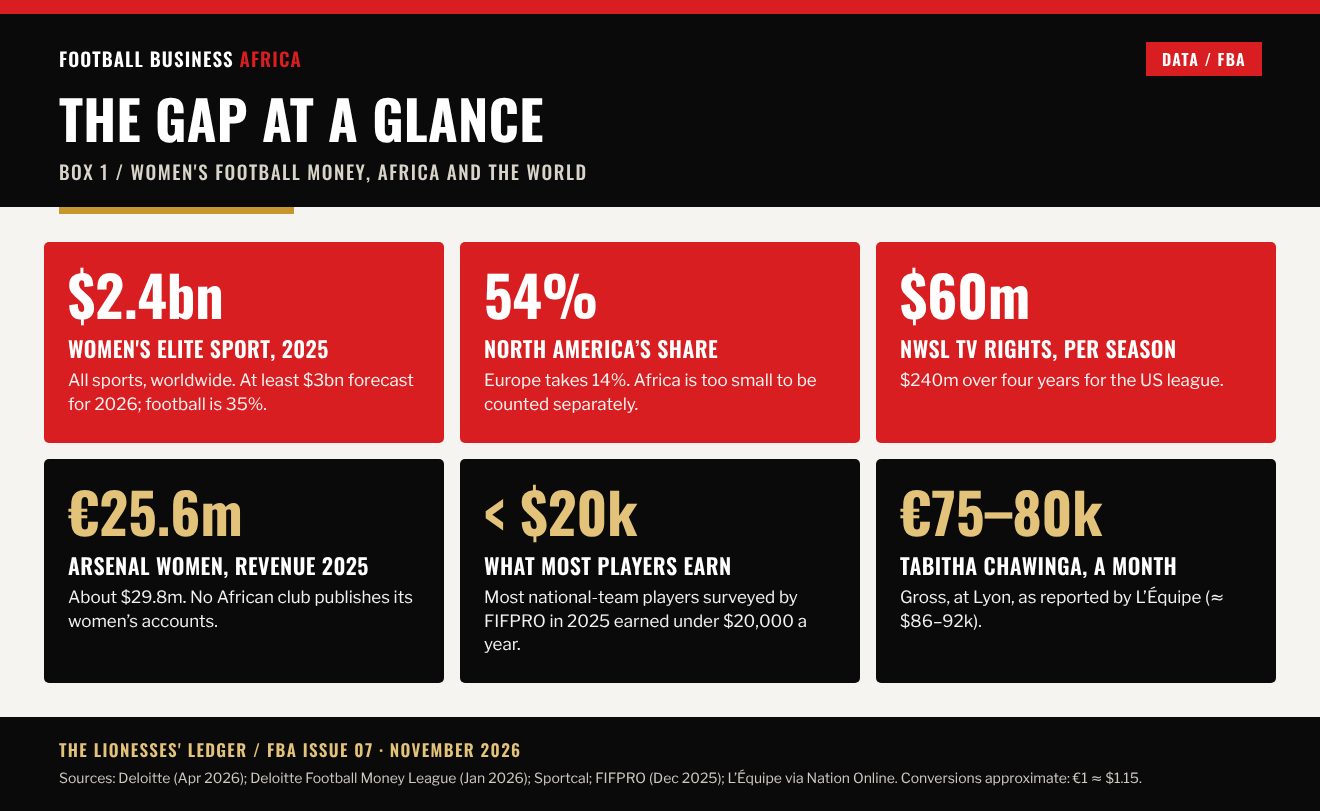
The Chawinga sisters of Malawi show the same thing in salaries. Temwa, the younger, arrived in Kansas City in 2024 and broke the American league's single-season scoring record in her first year; in 2026 she extended her contract to 2029. Tabitha, the elder, plays for Lyon. According to L'Équipe, she is the best-paid player in the French league, at a reported €75,000–80,000 (about $86,000–92,000) a month, gross.
There is a catch. None of these fees reached Africa. Kundananji's went to a Spanish club, Banda's to a Chinese one. Africa produces the stars; others collect the transfer value.
The League at Home
What a player earns in Lyon or Kansas City is, for most African footballers, a rumour from another planet. The view from home is more modest.
In Kenya, in March 2026, eleven clubs in the women's top division refused to play their weekend fixtures. Some players, according to Capital FM, had not been paid since the previous November. A title sponsor promised for the women's league never materialised, while the men's league had signed a ten-year, KSh1.12 billion (about $8.7 million) title sponsorship the previous July. The first sponsorship of any Kenyan women's competition, a betting company's backing of the Women's Cup, pays players KSh3,300 (about $26) each per victory, straight to their mobile-money accounts.
In Nigeria, the country of ten African titles, the women's league has struggled for decades to attract a title sponsor; for 2024/25 the league itself announced that its only approved sponsorship was a best-goalkeeper award worth ₦200,000, about $130.
South Africa does better. Since 2021 the Hollywoodbets Super League has had a betting-company sponsor worth R17 million a season at launch (about $940,000 today), with R2 million for the champions. Yet the league is still semi-professional, and the federation's own president has admitted that all the sponsorship in the women's game combined came to less than any single men's competition.
The exception is Morocco. In 2020 the Royal Moroccan Football Federation adopted a development plan that made professional contracts compulsory in the top division and multiplied the women's budget from about €1 million to €6 million (about $1.15 million to $6.9 million). Clubs receive regular federation funding; salaries, coaches say, now arrive on time. The results followed: finals of the Cup of Nations in 2022 and 2025, and a continental club title for AS FAR of Rabat in 2025.
Even Morocco's success shows how far there is to go. In January 2026, AS FAR travelled to London for FIFA's new Women's Champions Cup as champions of Africa. They lost their semi-final to Arsenal 6–0. Arsenal's women's team alone earned €25.6 million (about $29.8 million) in 2025, according to Deloitte. No African club publishes the accounts of its women's team.
A CAF survey gives the wider picture. In 2022, of all Africa's national women's leagues, only twelve had contracts with all their players, and only four paid every player a salary.
A sport that cannot measure its audience cannot sell it. In Rabat, the cameras were there. The next step is to count who was watching.
What Comes Next
The next twenty months will test whether money from above can finally seep downward.
Africa will send at least four teams to the 2027 Women's World Cup in Brazil: Cameroon, Malawi, Morocco and Algeria. South Africa and Ghana are still chasing a place through FIFA's inter-confederation play-offs, which run into early 2027. In October, FIFA approved $2.5 million in preparation money for each qualified team — more than Cameroon received for winning WAFCON — and the draw takes place in Rio on 11 December. FIFA has yet to publish the tournament's prize structure; The Guardian and Sky report a pot of about $220 million, double 2023's but a third of the $655 million paid at the men's World Cup in 2026. If even part of that reaches the players, a few weeks in Brazil could be worth more to an African footballer than several years of club wages. Whether it reaches her, rather than stopping at her federation, is the question Nigeria's champions spent sixteen months asking.
In 2028 comes the first Women's Club World Cup, with places for African clubs. The same year, the American league begins a new television contract, which will reset salaries in the league where Africa's best players increasingly choose to play.
The Bottom Line
African women's football is richer than it has ever been — at the top. Prize money has risen tenfold in five years, African players command global fees and salaries, and FIFA is about to pay African federations more to prepare for one World Cup than CAF pays to win the continental title.
But the money arrives as events, not as wages. It flows to federations, governments and foreign clubs before it reaches the players and leagues that make the game. Until there are minimum salaries, published accounts and rules that send a share of prize money straight to players, as UEFA and FIFA now require, the Lionesses' ledger will keep showing the same entry: record income at the top, arrears at the bottom.
And there is a quieter frontier: information. CAF publishes detailed audience figures for the men's Cup of Nations, but none for the women's. No league publishes a minimum wage. A sponsor that cannot see its return will not sign. For African women's football, the next title worth winning is a balance sheet.
Sources & further reading
- 01
The night in Rabat — Inside World Football
Cameroon beat Malawi 3–0 to win WAFCON 2026; the $2m prize and the 12-to-16 expansion. Read the source
- 02
Match report — Morocco World News
Venue, scorers and timings of the final at the Moulay El Hassan Stadium. Read the source
- 03
Prize money — CAF competitions grid, August 2026
WAFCON, Women's Champions League, AFCON and club-competition prize money. Read the source
- 04
The global market — Deloitte
Women's elite sport revenue: $2.4bn in 2025, at least $3bn in 2026; regional and football shares. Read the source
- 05
Richest clubs — Deloitte Football Money League (women)
Arsenal top the women's ranking with €25.6m in 2025. Read the source
- 06
Players' pay — FIFPRO national team survey, 2025
Most women's national-team players earn under $20,000 a year. Read the source
- 07
Nigeria's unpaid champions — Guardian Nigeria
Who blocked Tinubu's reward for the Falcons? Read the source
- 08
Nigeria pays, sixteen months on — allAfrica / NSC
The National Sports Commission confirms the $100,000 rewards, 2 November 2026. Read the source
- 09
Nigeria's exit — Al Jazeera
Cameroon eliminate the holders; Cameroon and Malawi reach the World Cup. Read the source
- 10
World Cup play-offs — Al Jazeera
South Africa end Nigeria's hopes; Ghana beat Côte d'Ivoire. Read the source
- 11
Transfers — FIFA, international transfers 2025
A record $28.6m spent on international women's transfers. Read the source
- 12
Transfers — FIFA, mid-year 2026 window
Men's clubs spent $9.89bn in a single window. Read the source
- 13
The Schröder record — Reuters via The Star
Häcken say Real Madrid paid a record fee, above Ovalle's $1.5m. Read the source
- 14
Kenya's boycott — Capital FM
Unpaid salaries and missing funds fuel the Women's Premier League boycott. Read the source
- 15
Kenya's men's league sponsorship — Citizen Digital
The KSh1.12bn, ten-year title sponsorship, July 2025. Read the source
- 16
FIFA's World Cup money — Africa Soccer
$2.5m preparation funding for each African qualifier. Read the source
- 17
World Cup prize pot — Inside World Football
Reported $220m for 2027, against $655m for the men in 2026. Read the source
- 18
The draw — FIFA
Final draw at Rio's Museum of Modern Art, 11 December 2026. Read the source
- 19
Women's Champions League 2026 — CAF
Eight clubs in Ismailia, 1–15 November; $600,000 for the winner. Read the source
Dollar conversions are approximate, at the exchange rate at signing where known and otherwise at 2026 rates. Figures marked "reported" come from press reports rather than official disclosures.