France has dominated world football for nearly three decades with squads drawn heavily from families with roots in Africa, the Caribbean and the wider former French empire. The usual explanations — immigration and elite coaching — are real but insufficient. The full story is a century in the making.
The newest-sounding statements sometimes say the oldest things. During the 2026 World Cup, Arsène Wenger attributed France’s enduring football success to two factors: the quality of its academies and “African immigration.” Some heard a tribute to the continent; others a long-overdue acknowledgement of what the diaspora has given Les Bleus.
But the most revealing thing about Wenger’s remark is its vocabulary. “African immigration” frames France’s success as a recent story — post-war migration and its descendants. That reading is not wrong. It is simply too small. The presence of players tracing their families to Dakar, Casablanca, Fort-de-France or Kinshasa is not a statistical accident, nor the product of a cultural or biological predisposition. It is the visible outcome of a social, demographic and political history in which the French empire — and everything that survived it — plays the decisive role.
France’s victories are not the relic of a vanished empire. They reveal the human and institutional continuities that outlived it.
The myth that won a World Cup
July 12, 1998, was never just a football result. Months after an election cycle dominated by immigration debates and a rising far right, France’s victory over Brazil became proof — or so the story went — that a diverse France could still make a nation. Three words did the work of a thousand policy papers: Black-Blanc-Beur.
Historian Laurent Dubois, in Soccer Empire, showed what the formula really achieved: it suspended France’s contradictions rather than resolving them. Inequality and discrimination did not disappear in 1998; they simply became temporarily invisible because sporting triumph produced a consensus that politics could not.
The fragility of that bargain was exposed within a decade. When the squad imploded at Knysna in 2010 — Nicolas Anelka expelled, players on strike — the same characteristics celebrated in victory, including youth, diversity and working-class origins, were repurposed to explain defeat. Sociologist Stéphane Beaud documented how the debate stopped being about tactics and became about who is legitimate to represent France.
When Les Bleus win, diversity is a national treasure. When they lose, it becomes an object of suspicion.
Older than immigration
Reducing French football to “African immigration” compresses centuries into a category invented for contemporary migration. The history runs deeper and starts long before independence.
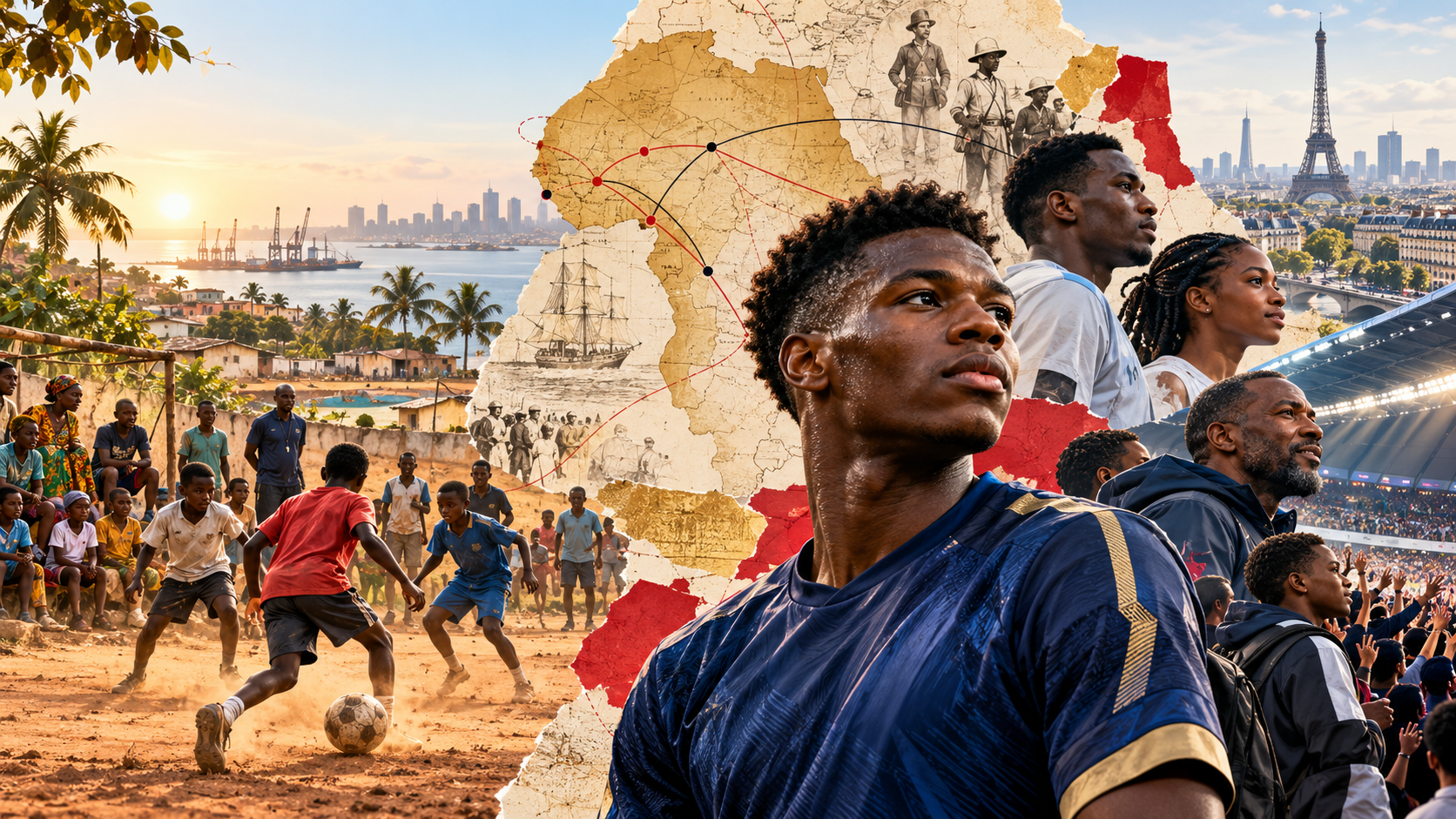
From the early twentieth century, football travelled through the empire alongside the school, the army and the colonial administration. Soldiers, missionaries, teachers and traders introduced the game; local societies rapidly made it their own. Clubs existed in Dakar, Brazzaville, Casablanca and Fort-de-France well before decolonisation. Colonial football reproduced the empire’s hierarchies — segregated competitions and European-dominated boardrooms — but it also built skills, networks and pathways that outlasted the system that created them.
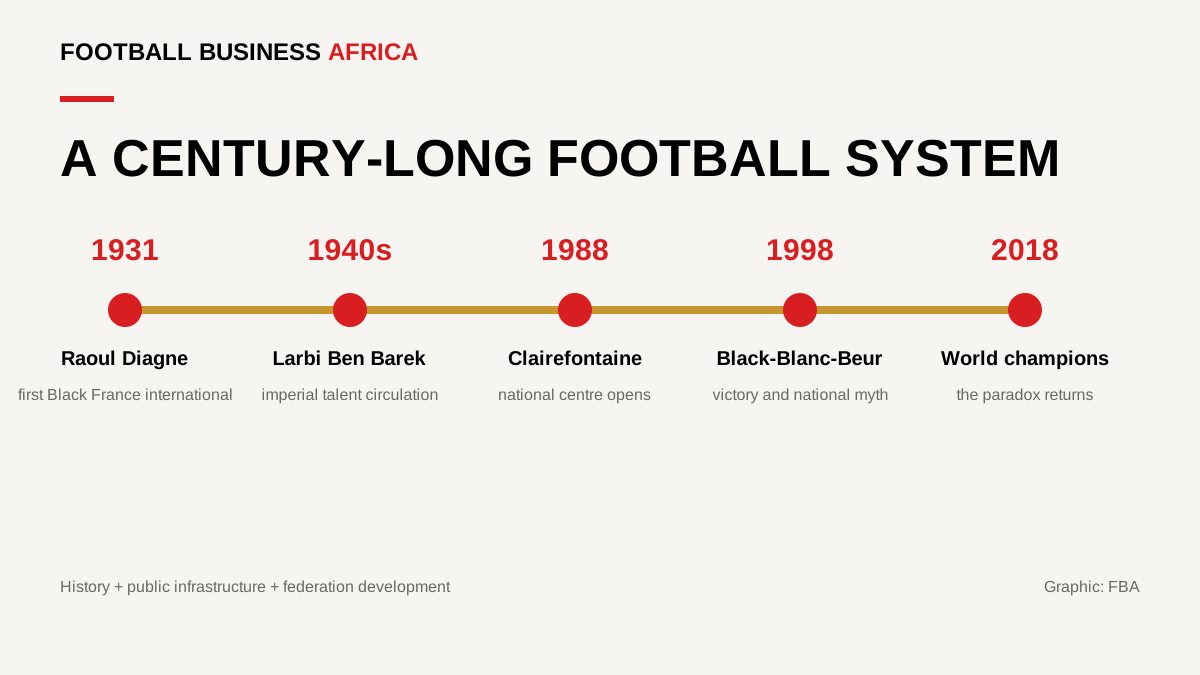
Two careers tell the story. In 1931, Raoul Diagne — son of Blaise Diagne, the first African elected to the French parliament — became the first Black player selected for France. A decade later, Casablanca-born Larbi Ben Barek became one of the finest players of his era. Both men prove the point: the circulation of talent between Africa and metropolitan France predates modern immigration by generations.
After 1945, the machinery scaled up. France recruited hundreds of thousands of workers from its colonies and former colonies to rebuild the country. The 1946 departmentalisation of Guadeloupe, Martinique, French Guiana and Réunion tied their populations to French citizenship, and from 1963 the state’s BUMIDOM agency actively organised migration from the overseas departments to the mainland. Many families behind today’s stars are not immigrants at all in the legal sense; they moved within a single political space.
As historians Frederick Cooper, Pap Ndiaye and Achille Mbembe have shown, the Black presence in France flows from a plurality of histories — slavery, colonisation, imperial citizenship, the overseas territories and migration. “African immigration” captures one strand. Empire explains the weave.
The talent machine
History explains why France has an exceptional human reservoir. It does not explain why that reservoir so reliably produces world champions. Talent only becomes a sporting asset when it is identified, developed and industrialised — and France has built a system few rivals fully match.
The visible tip is Clairefontaine, opened in 1988 and alma mater to Thierry Henry, Nicolas Anelka, Blaise Matuidi and Kylian Mbappé. But the real machine is beneath it: a federation-run pipeline of regional academies, sport-study schools and professional club training centres, staffed by thousands of coaches, scouts and volunteers, that spots players early and loses very few of them.
Feeding that pipeline is an asset rarely mentioned in highlight reels: decades of municipal investment. Since the post-war boom, French local authorities have built an unmatched mesh of public pitches, gymnasiums and amateur clubs, making football accessible to children regardless of family income. Before it was a globalised market, French football was a local public service.
Add a distinctive social geography. France’s big-city peripheries — none more famous than Seine-Saint-Denis, the youngest département in mainland France — concentrate dense, young, football-obsessed populations next to elite detection networks. Nothing “natural” is at work here; it is infrastructure meeting demography. In working-class territories, football also remains one of the last credible routes to rapid social mobility, which helps explain the depth of family and community investment in the game.
The result, confirmed in international player-export data, is that France ranks among the world’s leading exporters of professional footballers and regenerates its national team with remarkably few transition years. The 1998 champions gave way to the 2018 champions, who gave way to the next generation. Germany, the Netherlands, Portugal and Belgium each possess pieces of the system. France accumulated them all at once: imperial demographic depth, public sports infrastructure, a powerful federation and a dense amateur base.
The French paradox
And yet France struggles to talk about the history that powers its success. The 2011 “quotas affair” — leaked recordings of federation officials discussing limits on dual-national youth players — exposed the anxiety at the heart of the system: a training model unsettled by the multiple national belongings that French history itself produced.
The tension crystallised after the 2018 World Cup, when Trevor Noah joked that “Africa won the World Cup” and France’s ambassador to Washington replied that the players are French, full stop — the Republic does not define citizens by origin. Noah’s response went to the core: nobody disputes their nationality; the question is whether one can be fully French and claim African ancestry.
That exchange is the French paradox in miniature. Republican universalism protects individuals from being reduced to their origins, but it also makes the historical legacies that shaped their presence harder to name, measure and discuss. French football has spent a century learning to produce players from a post-imperial space. The Republic is still searching for the words to tell their story.
The bottom line
Wenger’s formula — elite coaching plus African immigration — is not wrong. It is incomplete. French football was not built by recent migration alone, but by the century-long articulation of imperial expansion, colonial citizenship, overseas departmentalisation, labour recruitment, public investment and one of the world’s most sophisticated development systems. That combination — an ecosystem, not a single cause — is what no rival has replicated.
Empires disappear from maps long before they disappear from societies.
None of this diminishes the players, coaches or volunteers behind three decades of dominance. It simply refuses to isolate football from the society that produced it. Empire’s legacies live on in institutions, territories, languages, families — and squad lists. Les Bleus therefore tell us less about a football team than about a nation whose past, often silently, continues to shape its present.
Sources & further reading
Public sources supporting the historical context, figures and examples in this article.
- 01
Laurent Dubois, Soccer Empire — University of California Press
- 02
French Football Federation — history of Clairefontaine
- 03
CIES Football Observatory — player export research
- 04
French football and colonial heritage — La Vie des idées
Published by Football Business Africa · 7 October 2026.