

African sports federations are rushing to adopt artificial intelligence, hoping to “leapfrog” traditional data infrastructure for instant results. That sequencing is fundamentally flawed. Without foundational data — basic player registries and verified records — AI is merely a black box that fails to solve local problems and risks reinforcing imported biases.
The illusion of leapfrogging
In the corridors of African sports ministries and federation boardrooms, a dangerous idea has taken hold: that artificial intelligence offers a shortcut to modernisation. Fuelled by technology vendors and global consultants, the narrative suggests that Africa can leapfrog the traditional, messy stages of industrial data collection directly into predictive analytics.
The reasoning is seductive. Why build laborious youth-player registries when an AI tool promises to identify the next Messi from video? Why spend years auditing paper files when machine learning can optimise league scheduling?
The reasoning is not merely optimistic; it is fatally flawed. AI is not magic. It is pattern recognition run on historical data — a hungry engine that requires high-quality, structured, historical fuel. The leapfrog fallacy ignores a fundamental law of information science: garbage in, garbage out. In the African context, there is an additional risk: nothing in, nothing out.
Consider Sevilla FC’s Scout Advisor, built with IBM. Scouts can use natural-language requests to search for particular profiles. But the system works because Sevilla accumulated more than 200,000 scouting reports over years. The club had the paper before the pixel; the database before the dashboard.
You cannot train an algorithm on a vacuum. Building predictive AI without a foundational player registry is like putting a roof on a house with no walls.
The sequencing error
We call this policy failure the sequencing error: attempting Stage 5 technology — predictive AI — while Stage 1 infrastructure — basic documentation — remains unbuilt.
The error is costly. It diverts limited resources away from the unglamorous but essential work of registering players, verifying ages and tracking injuries, towards glamorous but useless technological decoration. A federation that spends $100,000 on an AI licence while its player registry is stored in boxes is not innovating; it is performing innovation.
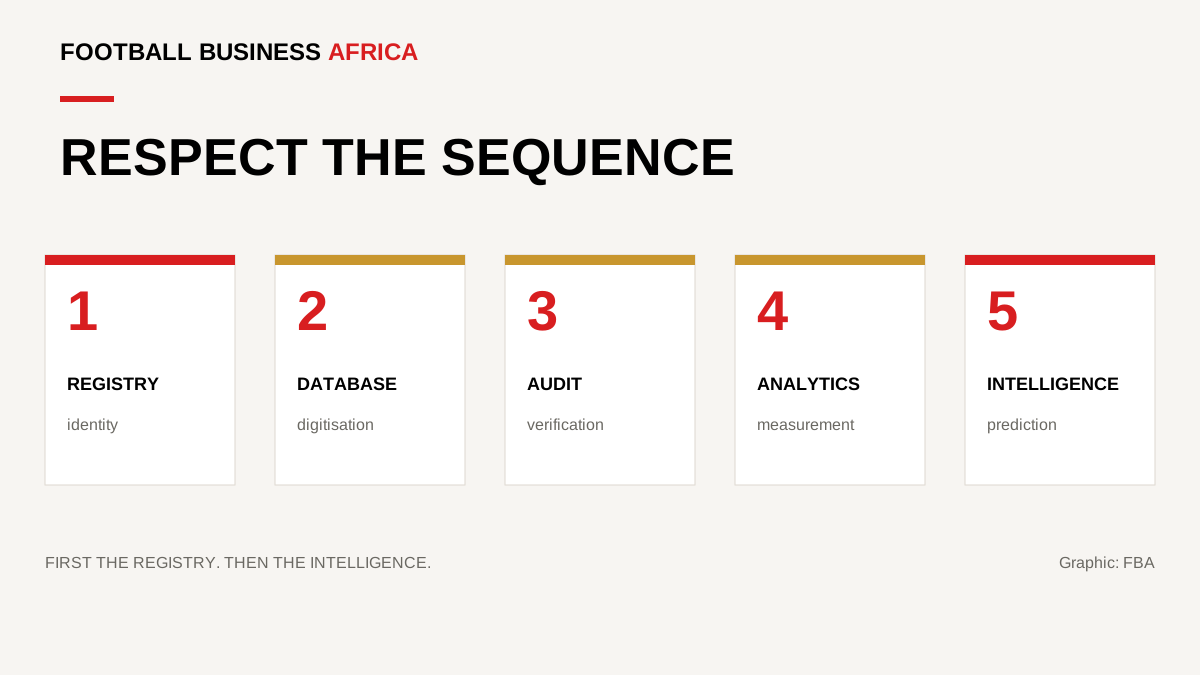
The hierarchy of data maturity is rigid: first the registry, then the database, then the audit, then analytics, and only then intelligence. Most African federations still struggle at the first stage. Jumping to the fifth guarantees disappointment. The policy mandate for the next decade must be to build the data, not merely buy the AI.
Algorithmic erasure
If we ignore that sequence and import off-the-shelf AI models from Europe or America, we introduce a second danger: algorithmic erasure.
AI models are not objective; they are cultural artefacts. They value what they were trained to value. A scouting algorithm trained on a decade of English Premier League data may learn to privilege high-intensity sprinting, physical collisions and structured positional discipline.
Applied to a match in Bamako or Kinshasa, it encounters a different football language. African midfield play can feature the pause, rhythmic change, tight-space dribbling and the feint. These are high-skill actions, yet they may register poorly on imported metrics. A player who pauses to draw a defender may be penalised for dwelling in possession; one who drifts to create an overload may be flagged for poor tactical discipline.
Without locally collected tracking data — without datasets describing what “good” looks like in African contexts — the model cannot be retrained. Local talent is judged with a ruler calibrated for another continent. Players can fail the data test even when they pass the eye test.
We are judging African poetry with a spellcheck designed for English prose. The tool sees errors because it does not understand the rhythm.
This produces the undervalued midfielder: a player who dominates locally but cannot secure a contract abroad because the statistics do not look right to the buyer. It is a form of algorithmic bias invited by the absence of data sovereignty.
The black-box problem
Reliance on imported AI also creates a dependency trap. If an algorithm says Player A is better than Player B but the federation cannot explain why because the model is proprietary, the federation has lost part of its sovereignty.
Selection decisions — who plays for the national team, who receives a scholarship — begin to be outsourced to the machine. If the machine is biased, the bias becomes automated and invisible. We risk creating data-optimised players: children who learn to please an algorithm with more sprints and safer passes rather than playing the game that wins the match.
Homegrown intelligence
Rejecting AI-first is not rejecting AI. It is a demand for homegrown intelligence: tools built to solve actual African problems.
We may not need an AI to tell us who is a good dribbler; coaches can see that. We do need entity-resolution systems able to establish whether “John Kamau,” born in 2008 in Nairobi, is the same person as “J. Kamau,” recorded as born in 2005 in Nakuru. This is the unglamorous plumbing of data science, but it tackles age and identity fraud.
We need pattern-recognition systems that can analyse low-resolution mobile-phone video, not only 4K broadcast feeds. We need infrastructure tools that optimise travel routes for teams operating in countries with poor roads, saving scarce budget.
This is the correct application of intelligence: solving the problems we have rather than the problems vendors want us to have. None of it can happen until the foundation exists.
First the registry. Then the intelligence.
Data infrastructure is not a bureaucratic delay before innovation. It is the condition that makes innovation useful, accountable and locally sovereign.
Sources & further reading
Public sources supporting the historical context, figures and examples in this article.
- 01
IBM — Sevilla FC Scout Advisor
- 02
FIFA Connect — football identity and registration
- 03
FIFPRO — player data rights
- 04
UNESCO — Recommendation on the Ethics of AI
Published by Football Business Africa · 7 October 2026.