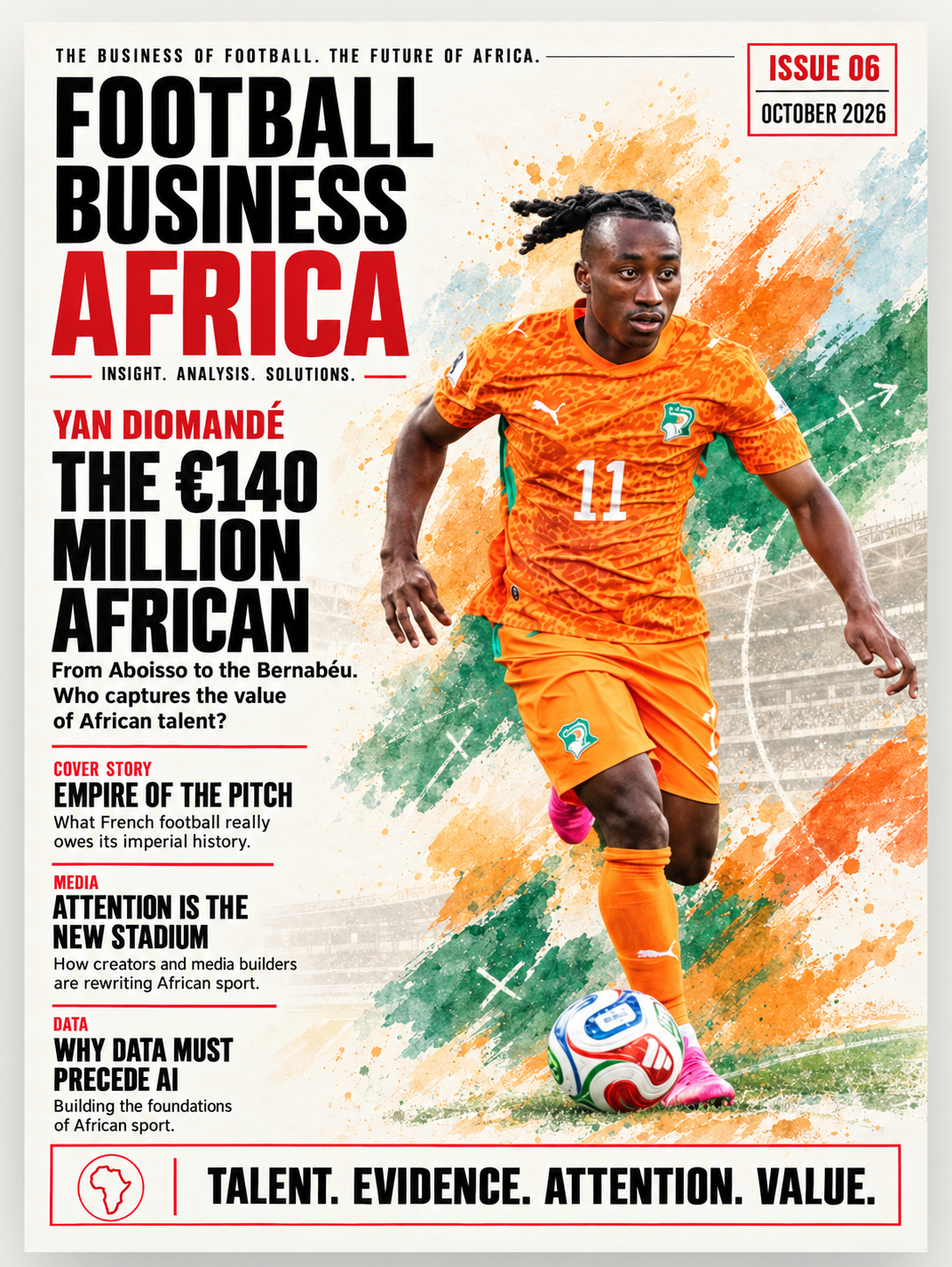
Before the €140 million valuation, before the Bundesliga data and before Real Madrid, there was Aboisso.
Yan Diomandé was nine when, by his own account in a letter published by The Players’ Tribune, he left home for Académie Inter Foot Sud Comoé, near Côte d’Ivoire’s border with Ghana.
It was not one of African football’s celebrated talent factories. But it gave him somewhere to live and train, away from his family. His description to So Foot captures the simplicity of the ambition: “On ne faisait que jouer au foot, en espérant pouvoir gagner notre vie avec.” (All we did was play football in the hope that we would make a living out of it).
Less than a decade later, the boy from Côte d’Ivoire would become the subject of one of the biggest transactions in football history.
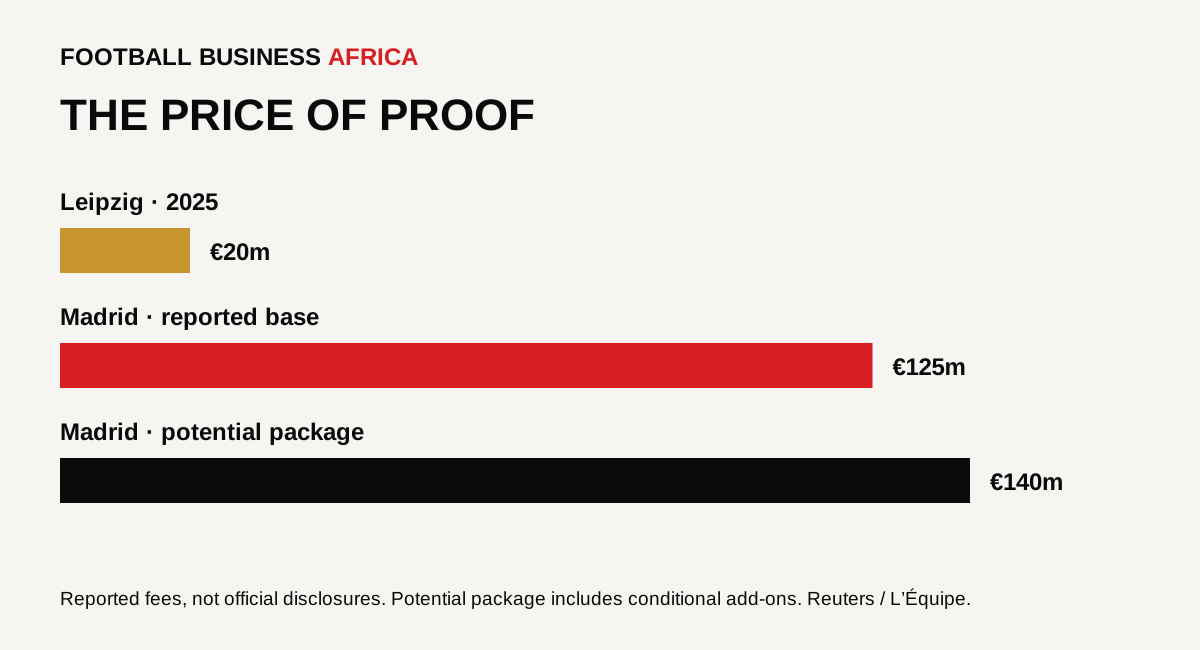
On 6 August 2026, Real Madrid announced an agreement with RB Leipzig for Diomandé and a contract running until 30 June 2033. Madrid did not disclose the fee. Reuters, citing Spanish media, reported €125 million plus €10–15 million in add-ons — potentially around €140 million.
That puts Diomandé in territory no African footballer had previously occupied. It far exceeds two recent benchmarks: the €80 million Arsenal paid Lille for Côte d’Ivoire’s Nicolas Pépé in 2019 and the €75 million plus up to €6 million in bonuses Manchester United agreed for Cameroon’s Bryan Mbeumo in 2025.
And it represents a remarkable re-pricing of a 19-year-old Ivorian who, only two seasons earlier, had yet to play senior European football.
The question for African football is therefore bigger than whether Real Madrid has overpaid.
How does a player developed in Côte d’Ivoire become worth as much as €140 million — and who captures the value created along the way?
The Talent Was African. The Valuation Came Later.
Diomandé’s pathway makes that question particularly interesting.
At 15, he left Côte d’Ivoire for DME Academy in Daytona Beach, Florida. He later told So Foot that he had already signed a pre-contract with Leganés but was too young to join the Spanish club. He recalled a teenager following a pathway largely determined by the adults around him: he was told to go to the United States, so he went.
Europe did not immediately open its doors either. Trials with several British clubs produced no contract. Eventually Leganés provided his breakthrough into senior European football.
Then the market moved extraordinarily quickly.
RB Leipzig paid around €20 million for him in 2025. Twelve months later, Madrid was prepared to guarantee more than six times that amount.
That transformation is one of the most revealing aspects of the transaction. Diomandé did not become six times more talented in twelve months.
What changed was the amount of credible evidence the market possessed about his talent.
At Leipzig, potential became measurable elite performance.
The player did not suddenly acquire talent in Europe. Europe acquired the evidence required to price his talent.
And measurable performance became an extraordinarily valuable asset.
The Data That Changed The Price
Diomandé’s 2025-26 Bundesliga season was exceptional.
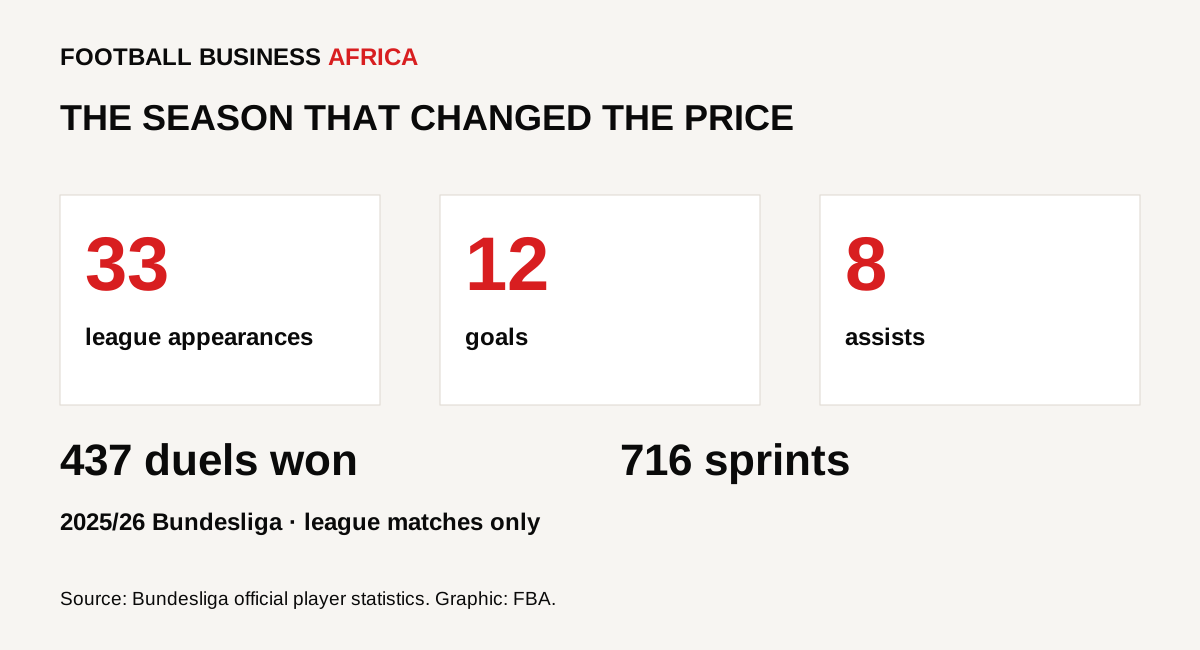
Official Bundesliga records show 12 goals and eight assists in 33 league appearances. He won 437 duels, while the league recorded 716 sprints, more than 2,170 intensive runs and a top speed of 36.3 km/h. He was subsequently named Bundesliga Rookie of the Season.
Opta’s numbers make the attacking profile even more striking.
Diomandé attempted 213 dribbles across Europe’s big five leagues, behind only Lamine Yamal and Vinícius Júnior. Among players attempting more than 100, his 55% success rate was the highest. He also recorded 21 drives into the penalty area and scored five goals following take-ons — more than any other player in the big five leagues.
Another Opta analysis found that in the Bundesliga he averaged 7.7 dribble attempts per 90 minutes, the most among players with at least 900 minutes, while completing 55.4%. He also registered 174 progressive carries of 10 metres or more, at least 13 more than any other Bundesliga player.
These are not merely spectacular-winger numbers.
They describe something increasingly scarce — and therefore increasingly expensive — in elite football: a player capable of repeatedly eliminating defenders and progressing possession while retaining the physical capacity to contribute without the ball.
Then-Leipzig coach Ole Werner described Diomandé as a “pretty complete package”, highlighting his capacity to keep defenders occupied, track back and attack opponents directly.
The distinction matters.
A spectacular dribbler can be found. A productive teenager can be found. A physically explosive winger can be found.
Finding all three in the same 19-year-old — already tested in one of Europe’s major leagues — dramatically reduces a buyer’s uncertainty.
And modern transfer markets price uncertainty.
Then Came The World Cup
The 2026 World Cup supplied the global validation.
Diomandé was outstanding in Côte d’Ivoire’s opening 1-0 victory over Ecuador. Opta recorded five chances created, 28 carries and 15 progressive carries in that match alone.
By the end of the group stage, the numbers were historic: Diomandé became the first player since 1990 to create at least 10 chances and complete at least 10 dribbles across his first three World Cup appearances. Côte d’Ivoire also reached the knockout stage for the first time.
Suddenly, the Bundesliga breakout was no longer merely a Bundesliga breakout.
Diomandé had reproduced his defining qualities against international opposition, under World Cup pressure and in football’s biggest global shop window.
The €140 million proposition was becoming easier to understand.
From €20M To €140M: The Value-Capture Question
This is where Diomandé’s story becomes particularly relevant to African football.
He learned his football in Côte d’Ivoire.
But the spectacular appreciation of his economic value occurred after he entered Europe’s institutional machinery.
Leganés provided the first senior European proof. Leipzig provided elite competition, coaching, visibility and statistical validation. Madrid then purchased the finished evidence, beating Liverpool and Paris Saint-Germain to the finish line.
The pathway tells its own story:
Côte d’Ivoire → United States → Leganés → RB Leipzig (~€20m) → Real Madrid (up to ~€140m).
Leganés also protected its position in the value chain through a reported sell-on clause. Public reports differ on whether the entitlement is calculated on the fee or Leipzig’s profit, and on the applicable percentage. The final payment is not publicly confirmed. The important distinction is that a contractual stake can preserve value after a player leaves.
Inter Foot Sud Comoé’s position is less clear. Under FIFA’s solidarity mechanism, registered clubs involved in a player’s training between the ages of 12 and 23 can be entitled to a share of compensation from an international transfer. But the precise amount in this case would depend on the academy’s registration status, the seasons for which it formally registered Diomandé and whether the relevant claim has been made.
The contrast illustrates the larger issue.
African clubs and academies frequently occupy the earliest — and cheapest — part of football’s value chain. Players leave while uncertainty surrounding their ultimate level remains high. European clubs absorb that uncertainty, generate trusted performance evidence and consequently capture much of the appreciation when the player succeeds.
Diomandé’s transfer takes that familiar mechanism and magnifies it.
The player did not suddenly acquire talent in Europe. Europe acquired the evidence required to price his talent.
Africa’s next frontier therefore cannot simply be talent production.
It must be value capture.
Africa’s next frontier cannot simply be talent production. It must be value capture.
The Fight Around A €140 Million Asset
The transfer also demonstrated what happens when the economic value surrounding a player explodes.
On 6 February 2026, Diomandé signed with Roc Nation Sports International. The following day, Maxidel Management — the agency founded by former Côte d’Ivoire captain Max-Alain Gradel — publicly challenged the move, saying Diomandé remained contractually bound to it and announcing its intention to take the dispute to FIFA.
Maxidel had been involved in his move from Leganés to Leipzig. By August, AS reported that the dispute had become an obstacle to completing the Madrid transfer while the competing representation claims were being considered.
But Diomandé contests Maxidel’s account.
In an interview with So Foot, subsequently reported by Sport-Ivoire in May, he was unequivocal: “Je n’avais pas de contrat avec lui.” His version was that Gradel had facilitated the Leipzig deal and subsequently wanted him to join Maxidel, but that Diomandé declined.
Maxidel maintains the opposite. Sport News Africa reported agent Jean-Martial Lopoh as saying the agency possessed documentation supporting its claim to an extended representation agreement.
These remain contested contractual claims, not established wrongdoing by Diomandé, Maxidel or Roc Nation.
But the dispute exposes a serious structural issue.
Young African players can encounter representation agreements, image-rights arrangements and cross-border contractual relationships long before anybody knows what their eventual economic value will be. Once that value reaches nine figures, control over the commercial ecosystem around the athlete can itself be worth millions.
Athlete education and independent legal advice are therefore not peripheral welfare issues.
They are part of African football’s economic infrastructure.
The Other Price Of Success
The scrutiny did not stop with his representation.
Viral social-media posts questioned Diomandé’s age, with one allegation using an old photograph supposedly taken in 2013 to argue that he was considerably older than his registered age.
No credible evidence has emerged establishing that Diomandé falsified his age, and no official documentation contradicting his registered birth date of 14 November 2006 has been made public.
An old photograph circulating online is not, by itself, evidence of a false birth date. Such allegations require reliable provenance and official documentation.
The broader lesson is uncomfortable.
Historical cases of age fraud in African football have created a ready-made stereotype through which young African players can be subjected to suspicion unsupported in their individual cases. The higher the price and the faster the ascent, the more intense that scrutiny can become.
Legitimate scrutiny of documentation is one thing. Converting nationality or race into presumptive evidence is another.
A New Ceiling For African Talent
There remains considerable risk in Madrid’s investment.
Nineteen-year-olds do not develop in straight lines. Bundesliga dominance does not guarantee dominance at the Bernabéu. And a transfer package potentially approaching €140 million creates expectations no statistical model can neutralise.
Diomandé appears conscious of that.
After his first Madrid training sessions, he told Realmadrid TV that the level was “tougher” and that he needed to work harder. Later that month, he described sharing a dressing room with players he had previously watched on television as “like a dream”.
Whatever happens next, however, an important threshold has already been crossed.
African footballers have long starred for Europe’s biggest clubs. From Rabah Madjer, Geremi Njitap to Samuel Eto’o and Didier Drogba, they have won Champions Leagues and Premier Leagues and, in George Weah’s case in 1995, a Ballon d’Or.
What is different here is the market’s willingness to attach an extraordinary forward-looking valuation to an African teenager.
That is significant.
But African football should resist celebrating the headline number without examining the economics beneath it.
The real breakthrough will not come when another African footballer costs €150 million.
It will come when African academies, clubs and football institutions possess the scouting systems, performance data, contractual expertise, athlete-protection mechanisms and negotiating power necessary to retain a substantially greater share of the value they create.
Yan Diomandé’s journey began on Ivorian pitches, not in a European analytics department.
The €140 million came later.
That may be the most important data point of all.
Sources & further reading
- 01
Real Madrid — official transfer announcement
- 02
Reuters — reported fee and contract
- 03
Bundesliga — official 2025/26 statistics
- 04
Opta Analyst — transfer journey and performance analysis
- 05
Opta Analyst — World Cup players to watch
- 06
Opta Analyst — Curaçao v Côte d’Ivoire match data
- 07
The Players’ Tribune — Dear Roxane, by Yan Diomandé
- 08
So Foot — interview with Yan Diomandé
- 09
AS — reported Leganés sell-on proceeds
- 10
AS — competing representation claims
- 11
Sport-Ivoire — Diomandé’s response to the representation dispute
- 12
Sport News Africa — Maxidel’s account
- 13
FIFA — training rewards and solidarity